
Disappearing Opportunities
ATMOSPHERIC ROLE OF FORESTS: RAINFORESTS AND CLIMATE
July 22, 2012Rainforests play the important role of locking up atmospheric carbon in their vegetation via photosynthesis. When forests are burned, degraded, or cleared, the opposite effect occurs: large amounts of carbon are released into the atmosphere as carbon dioxide along with other greenhouse gases (nitrous oxide, methane, and other nitrogen oxides). The clearing and burning of tropical forests and peatlands releases more than a billion metric tons of carbon (3.7 billion tons of carbon dioxide) into the atmosphere each year, or about more than ten percent of anthropogenic carbon emissions.
The buildup of carbon dioxide and other gases in the atmosphere is known as the "greenhouse effect." The accumulation of these gases is believed to have altered the earth's radiative balance, meaning more of the sun's heat is absorbed and trapped inside the earth's atmosphere, producing global warming. Greenhouse gases like carbon dioxide are transparent to incoming shortwave solar radiation. This radiation reaches the earth's surface, heats it, and re-radiates it as long-wave radiation. Greenhouse gases are opaque to long-wave radiation and therefore, heat is trapped in the atmosphere. As greenhouse gases build up, this opacity is increased and more heat is trapped in the atmosphere.
The largest anthropogenic contributor to the greenhouse effect is carbon dioxide gas emissions, more than 85 percent of which comes from the combustion of fossil fuels (roughly one percent of emissions result from from energy-costly production activities like the manufacture of concrete, steel, and aluminum). The preindustrial atmospheric concentration of carbon dioxide was 280 ppm, though today levels have risen to 400 ppm, a 43 percent increase. Climatologists estimate that a level of 450 ppm—as projected for 2050—may result in an eventual 1.8-3 degrees Celsius (3.2-5.4 degrees Fahrenheit) increase in temperature. Some scientists predict that global warming will produce a sharp upswing in global temperatures followed by a deep plunge into a glacial period several thousands years from now. However, there are still a lot of unknowns about the impact of climate change.
The extent and effect of global warming has been long debated by scientists, industries, and politicians. In 1995 leading scientists and the Intergovernmental Panel on Climate Change (IPCC) concluded that global warming had been detected and that "the balance of evidence suggests a discernible human influence on global climate." Their evidence included a 0.5-1F (0.3 to 0.6C) increase in average global temperature since 1960, a 4.5F (2.5C) degree increase at the Earth's poles, the breaking up of the Antarctic ice sheets, the receding of glaciers worldwide, the longest El Niño ever recorded, a record number of hurricanes in 1995, a record number of heat waves, and an increase of epidemics attributed to global climate change, including dengue fever, malaria, hanta virus, and the plague. According to scientists at the National Oceanic and Atmospheric Administration, 1998 was the warmest year on record, although 2005 was a close second. A British study at the University of East Anglia suggested that 1998 may be the warmest year in over 800 years. The 1990s have been the warmest decade of the millennium and the past decade has witnessed nine of the eleven hottest years this century. In the 900 years before the twentieth century, temperatures dropped an average of 0.02 degrees C (0.04 degrees F) per century.
Since 1960 atmospheric carbon-dioxide levels have increased from 313 ppm to 400 ppm (28 percent increase), according to measurements from Mauna Loa observatory, and carbon-dioxide levels are now 27 percent higher than at any point in the last 650,000 years. The Intergovernmental Panel on Climate Change (IPCC) projects that atmospheric carbon-dioxide levels could reach 450-550 ppm by 2050, possibly resulting in higher temperatures and rising sea levels, along with a myriad of potential impacts ranging from increased storm and hurricane intensity [news]; melting of polar ice [news], Arctic permafrost, and glaciers [news]; changes in ocean currents including the Gulf Stream; a rise in global sea levels [sea levels] which could inundate low-elevation cities like Cairo, Venice, Lagos, New Orleans, and Amsterdam and cause problems for low-lying nations; increased coral bleaching and mortality of reef ecosystems; changes in ecosystems; species migration and mass extinction, especially among cold climate species; heightened danger from human pollutants like ozone; health impacts including the spread of tropical disease into cooler climates and range expansion of other pathogens; and water shortages.Rising sea levels
The projected rise in sea level from ocean-water expansion and ice melt varies depending on estimates of global warming. But there is a good chance that oceans will rise from 10 inches (25 cm) to 20 inches (50 cm) within the next century if greenhouse gas emission rates continue at present levels. Such a rise in sea level does not sound like much, but it would have profound effects on both humankind and natural systems. Any sea-level increase would be magnified during tides, storm surges, and hurricanes and could have a devastating impact as shown by Category 3 Hurricane Katrina in 2005. Island nations like the Maldives and scattered South Pacific republics face extinction.
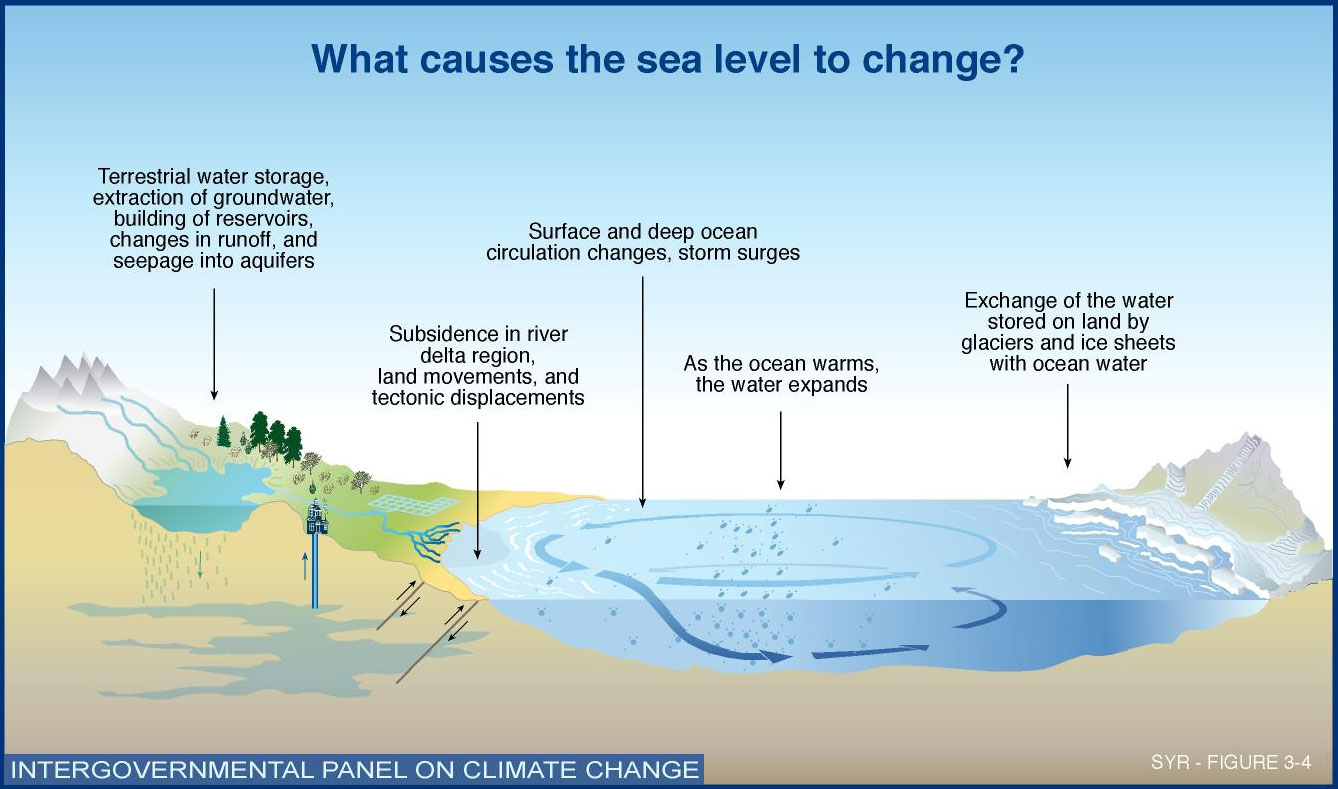
The sea is a tremendously important resource for man, and some of the world's largest cities lie along the coast for trade and commercial fishing. Any rise in sea level would directly affect these metropolises, causing flooding and the potential disruption of sewage and transit systems, along with inundating neighboring agricultural plots. A change in sea levels will also affect coastal ecosystems like river deltas, wetlands, swamps, and low-lying forests, which play an important role in providing services for mankind, in addition to housing biological diversity. Though sea levels have been higher in the past, today there is less room for species affected by flooding, since buildings and concrete now occupy the areas that were once extensions of their environment. Modern humankind is so dependent on existing conditions, that a change in sea level, even if it is 10-20-inch (25-50 cm) will have a drastic effect on our society. Global warming is as much a social problem as it is an environmental one.
Changes in ecosystems
Scientists expect climate change to cause major shifts in species distribution and ecosystems, though there is still considerable debate over how climate change will affect specific ecosystems. Moderate climate warming simulations show that coral reefs will decline significantly over the next 50 years due to higher water temperatures and increased ocean acidity, and a similar fate will befall many organisms that form the base of the oceanic food chain. On land, permafrost across frozen landscapes may melt and give way to forest vegetation, while agricultural belts may move polewards. In the Amazon, temperatures are expected to climb, resulting in drier forests and expanded savanna. In Africa, climate change may disrupt regular seasonal weather patterns over large regions of the continent, reducing rainfall in some areas while producing more rainfall in the drought-stricken Sahel region.
The good news is that some carbon emissions can be canceled out by planting trees, which absorb carbon into their tissue through photosynthesis. Tropical forests have the best potential for the mitigation of greenhouse gases since have the greatest capacity to store carbon in their tissues as they grow. Reforestation of 3.9 million square miles (10 million square km) could sequester 3.7-5.5 billion metric tons of carbon dioxide over the next 50-100 years.
Already a number of tree-planting projects specifically designated for carbon-emissions mitigation have been initiated around the world, including a proposal by a coalition of developing countries at the 2005 UN climate conference in Montreal to seek compensation in the form of carbon payments for forest conservation. This proposal has since developed into the so-called Reducing Emissions from Deforestation and Degradation or REDD+ mechanism, which is expected to mobilize tens of billions of dollars in carbon finance for tropical forest conservation. [Latest news on avoid deforestation, carbon finance, and REDD].
While schemes like REDD+ could provide ways for poor tropical countries to capitalize on their natural assets without destroying them, the bad news is that even if carbon emissions are reversed today there is a lag time of around 50 years before the effects can be slowed, because of ocean thermal inertia, or their capacity to store heat. Thus the effects from past emissions are not entirely apparent today.
Lungs of the Earth
While the role of rainforests in oxygen generation is often overstated—more oxygen is produced by microorganisms in the world's oceans—tropical rainforests do produce oxygen as a by-product of photosynthesis. Some scientists estimate that 20 percent of the planet's oxygen is generated by rainforests. However oxygen production by tropical forests is largely offset by plant respiration, which occurs at night.
Therefore it's more appropriate to think of rainforests being "the lungs of the Earth" for their role in storing carbon and adding to local humidity.
Review questions:
- How does deforestation affect global warming?
- Why are rainforests called "the lungs of the world"?
Other versions of this page
spanish | french | portuguese | chinese | japaneseContinued / Next: Extinction