TROPICAL RAINFORESTS: Imperiled Riches—Threatened Rainforests
The Asian Forest Fires of 1997-1998
From October through November 1997, fires in Indonesia and the resulting haze made front-page news around the world as the haze spread as far the Philippines to the north, Sri Lanka to the west, and northern Australia to the south. As the Southeast Asian "tiger" economies collapsed, fires burned thousands of squares miles of rainforest, plantations, conversion forest, and scrubland in Kalimantan, Sumatra, Sulawesi, Irian Jaya, Papua New Guinea, Bali, Lombock, and Sarawak, Malaysia. Though official government estimates peg the area affected at 1.85 million acres (750,000 ha), environmental organizations like the national environmental group WAHLI (the Indonesian Forum for Environment) say at least 4.2 million acres (1,714,000 ha) went up in smoke By mid-1998 the estimate had climbed beyond 5 million ha (12.4 million acres). Estimates for the area burned in East Kalimantan alone in 1998 range from 445,000 acres (180,280 ha) to 700,000 acres (284,000 ha). Regardless of the extent of area burned, the fires caused serious regional health problems and economic loss, and created an ecological nightmare.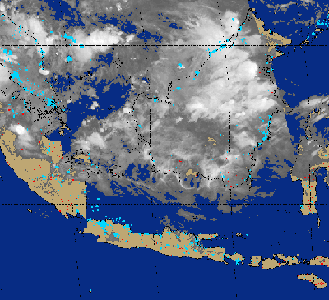
Sulfides, nitrous oxides, and ash released by burning, combined with the industrial pollution and exhaust from cities, formed choking haze that raised pollution levels to previously unrecorded heights. The Air Pollution Index exceeded 800 (a day's exposure to an API of 200-300 is the equivalent to smoking 20 cigarettes) in Kuching, Malaysia, and set record highs in Singapore and Kuala Lumpur, Malaysia. While over 200,000 were hospitalized with ailments including heart and respiratory disorders, severe nosebleeds, and eye irritation, there is greater concern for the long- term health effects on the more than 70 million people in six countries affected by the haze. Health officials worry that the smog produced by the fires may lead to an increase in heart, lung, brain, eye, and skin disorders over the next decade.
The fires and haze compounded the woes of the region's economies, which have been reeling from a dive in investor confidence, over-inflated property values, and improper business practices, leading to widespread bank failures and a downturn in currencies. The fires are projected to have major economic effects: WAHLI predicted a $3.15 billion loss for 1997 alone, while the Economy and Environment Programme for Southeast Asia (EEPSEA) estimated that total losses for 1997 and 1998 could be $5-6 billion after accounting for loss of timber, biodiversity, and plantations, as well as for long-term health effects. The haze blocked out the sun in some regions, affecting the ripening of fruits and wreaking havoc on transportation; the effects included airport closings, boat accidents, and even a Garuda Airbus a-300 plane crash that killed all 234 people on board. Coffee production declined 40 percent, while palm-oil harvests were down 30 percent after fires burned plantations and interfered with transport. Tourism, Malaysia's second largest foreign-currency owner in 1996 at $4.5 billion, was clobbered by the haze, and the government issued a ban on all media coverage of the fires.
The fires have been called a "planetary disaster" by the World Wildlife Fund (WWF) for their wide-ranging ecological effects. The lowland tropical rainforests of Sumatra and Borneo are considered some of the most biologically diverse on Earth. They have already been heavily impacted by logging and conversion for plantations and agricultural projects. According to IUCN, 19 national parks and reserves were affected by the fires and more than 150,000 acres (60,000 ha) of protected forest are gone. In 1998, more than 112,000 acres (45,500 ha) of protected forest in East Kalimantan were lost including the forest surrounding the Wanariset Orangutan Reserve. The smoke from the fires will have a major impact on the ecology of the region. The smoke has reduced sunlight, decreasing the length of the day by 20 percent and slowing photosynthesis, thus reducing the amount of energy in the forest system. Recent studies in the Amazon suggest that the blockage of sunlight may encourage the spread of harmful bacteria and viruses. Smog absorbs UV-B light, reducing its presence and allowing airborne bacteria that lack internal pigmentation (as most pathogens do) to become more abundant. The smoke also affects the navigation systems of bees which feed less and pollinate fewer trees, meaning that there is less food for fruit-eating animals and herbivores and subsequently less prey for predators. According to a study by Mulawarman University, the fires brought the insect index from 30 down to 5. After the fires, only four species of arophola butterfly have been rediscovered in Wanariset forest, where only a year earlier there were 180 species. WWF studies have shown that fruit-eating birds and orangutans suffered greatly from the fires of 1982-1983 in Borneo since the trees on which they feed take many years to mature and fruit. As animal populations, especially insect populations, fall, the food chain is thrown out of balance. Animals are also suffering respiratory ailments from the haze and are leaving the forest to escape the fires and search for food. As a result, reports of conflicts between wildlife and humans have increased substantially and endangered Sumatran tigers have mauled three people to death. There are widespread reports of villagers killing endangered adult orangutans with machetes as they flee the burning forests and selling the young for $50 to animal smugglers. Interestingly, one of the unexpected results of the fires is reports of sightings of the Java tiger, declared extinct in the 1970s; however, experts are cautious about the validity of the reports.
There is concern over the long-term ecological effects of the fires, especially those burning in the peat bogs of Kalimantan, Borneo. Peat forests have the potential to burn for years, and in fact some are still burning from the forest fires of 1982-1983. Fires in peat bogs are especially difficult to extinguish, because they can burn deep underground. Even monsoon rains will not put them out. Of special significance is the amount of carbon dioxide being released by the fires in the peat bogs. Peat bogs normally act as massive carbon sinks, absorbing vast amounts of carbon from the atmosphere. They also serve as natural sponges, soaking up rain during the dry season, and slowly releasing moisture into the air during the dry spells to maintain local humidity. The Center for International Forestry Research says that the majority of air pollution is coming from fires in the "One Million Hectare Project" in Central Kalimantan, a giant peat marsh being drained for rice production. The project was launched by Suharto in 1995 to boost rice production by 2.7 million tons per year and relocate 300,000 families from Java to the lowland region of central Kalimantan. Many are skeptical about the project, the first stage of which has cost $242 million. Previous similar projects have met little success, since, most agricultural experts agree, peat swamps are unsuitable for rice cultivation. In the past, farmers have failed and returned to the central islands. As the peat is exposed by forest clearing, it quickly dries out leaving it extremely flammable. As the forest and bush are burned, the peat ignites. The fires burn so hot that they can create a layer of silicon impervious to water, making any form of irrigation nearly impossible. Wetlands International reported that damage caused during the first three months of fires may result in a 5 percent increase in greenhouse gases emissions for the year, while WWF estimated that in the first six months, the fires could release more carbon dioxide than "the entire annual contribution from cars and power stations in Western Europe."
When the monsoon rains do come, Indonesia can expect widespread flooding and massive erosion. The loss of vegetation means that heavy tropical rains will wash away the loose topsoil. Sure enough, in 1998-1999 deadly flooding in Indonesia and Malaysia inflicted heavy damage and caused significant loss of life. There is a strong possibility of acid rain formed from the sulfur released by the burning. The acid rain could make soils more acidic and affect agriculture while damaging remaining forests.
Fires have burned forest lands in Indonesia for thousands of years, but in recent times fires have become more frequent and widespread due to human-induced changes in the forest ecosystem. During the El Ni�o of 1982-83, fires burned about 9.1 million acres (3.7 million hectares) of forest degraded by commercial logging and agriculture in Kalimantan. These fires may have been the largest in human history. In 1987, another 5 million acres (2 million ha) of forest, 70 percent of which was primary forest, went up in smoke in Kalimantan, Sumatra, East Timor, Sulawesi, and Java. In 1991, fires burned more than 125,000 acres (50,000 ha) of forest.
Scrub, grassland, logged-over forest, and rainforest are routinely cleared for cash crops like oil palm and rubber. Indonesia's goal for the year 2000 was to have 5.5 million hectares of oil-palm plantation, double its previous area. By 2020, the government hopes to convert more than 40 million acres (16 million ha) of forest land into farmland and living space. The cheapest way to clear new land is to clear-cut the trees followed by burning. During the first nine months of 1997, the government approved 750,000 acres (300,000 ha) of primary rainforest for conversion to palm-oil plantations. The fires set for forest clearing burn every year, but are usually extinguished by monsoon rains that once fell predictably every November. However, in some recent years, the prolonged dry spells caused by El Ni�o have suppressed the annual northeast monsoon, delaying rains and allowing fires to rage out of control. Rainforests rarely burn on their own because they are so wet; however degraded "conversion" forest which has been intensively logged can become dangerously flammable during dry conditions like those induced by El Ni�o. Once conversion forest is ignited, fires can jump into primary forest.
As criticism mounted from neighbors experiencing the ill-effects of the haze, Indonesian officials tried to pin blame on El Ni�o and small farmers. However satellite pictures showed otherwise: about 80 percent of the fires coincided with plantations and timber concessions.
|
|
|
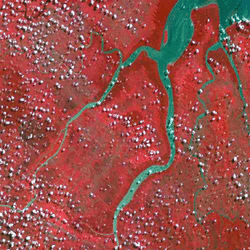

Though timber barons vehemently denied having any part in the fires, publicly released satellite pictures clearly showed fires burning in conversion forests surrounding oil-palm plantations and in timber concession areas. The satellite photos were a public relations slap in the face of wealthy plantation owners and timber operators like Mohammed "Bob" Hasan, a close confidante of ex-president Suharto, who maintained that the fires were caused by El Ni�o, small farmers, and "timber smugglers." The environmental minister tracked the fires to 176 plantations and forestry concessions, and revoked 144 licenses of 29 companies, including three linked to Hasan. The government promised that those who broke the law would be prosecuted under the 1995 law that bans forest burning, punishable by up to ten years' imprisonment or a $33,000 fine. However, by December 1997, 45 of the timber exploration licenses had been reinstated, including the three linked to Hasan. By March of 1998, only five of the firms had been prosecuted. Similarly, in Malaysia, 17 companies were fined a collective $8,000 for ignoring the no-burn policy.
The weak enforcement of environmental law is not new in Indonesia. In 1996, 60 forestry licenses were not renewed; poor land management was cited. But the companies continued to operate as if nothing had happened. The major obstacles impeding reform are the strong political and economic ties between Indonesia's governing elite and the timber barons. Suharto, in addition to having family ties in the timber and plantation industries, has close business links to many of Indonesia's wealthiest plantation and logging-concession owners. Timber barons and plantation owners appear to be above the law as none have ever been convicted under the 1995 law despite widespread fire setting.
People are desperately looking for something good to come out of the fires. If nothing else, the fires brought international recognition of Indonesia's titanic problem of deforestation. Observers hope that the fires may induce Indonesia to amend some of its misguided development schemes and end some of the wasteful practices and corruption that have helped stimulate its economic freefall.
Continued: Economic Restructuring