TROPICAL RAINFORESTS: Imperiled Riches—Threatened Rainforests
 Home
 What's New
 About
 Contribute
 Submissions
 Rainforests
   Mission
   Introduction
   Characteristics
   Biodiversity
   The Canopy
   Forest Floor
   Forest Waters
   Indigenous People
   Deforestation
   Consequences
   Saving Rainforests
   Amazon rainforest
   Borneo rainforest
   Congo rainforest
   Country Profiles
   Statistics
   Works Cited
   For Kids
   For Teachers
   Photos/Images
   Expert Interviews
   Rainforest News
   XML Feeds
   Chinese
   French
   Japanese
   Spanish
   Other Languages
 Pictures
 Books
 Links
 Newsletter
 Education
 Mongabay Sites
   Kids' site
   Travel Tips
   Tropical Fish
   Madagascar
 Contact


About this site
Providing tropical forest news, statistics, photos, and information, rainforests.mongabay.com is the world's most popular rainforest site. [more]


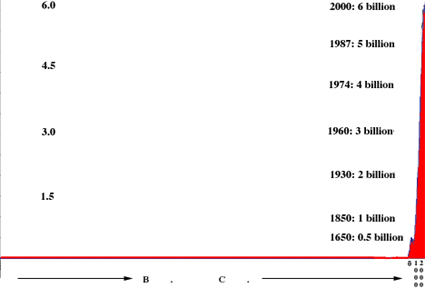
Human Population Growth


The graph above shows human population growth over the past 25,000 years or so. As evident, the graph is fairly boring—there is a virtually constant human population, up until around 1 A.D., when growth rates accelerate. The small downward spike during the mid-2nd millennium A.D. reflects the impact of the black plague. By the mid-19th century population growth reaches exponential proportions, a trend that continues today.


Though human population is still increasing at a substantial rate, the birth rate worldwide has peaked and now looks to be declining. This means that each woman is having fewer children. However, the problem remains that least-developed countries still have a huge population that is yet to reproduce (under the age of 15). In the coming years, as these women begin to reproduce, the population will continue to expand.

What is the best way to slow population growth? Many will argue, citing numerous studies, that women's education has the most significant effect in curbing the number of children they have. Encouraging later marriages, say marrying at 21 instead of 16, can also materially reduce the number of children brought into the world each year, as can improved access to contraceptives.

Population Growth Profile, 1998.

Region

New growth (millions)

New growth (%)

Sub-Saharan Africa

15.7

20.0

Nigeria

3.3

 
Congo (Kinshasa)

1.4

 
Ethiopia

1.3

 
Near East and North Africa

7.1

9.0

Egypt

1.2

 
Turkey

1.0

 
Asia and Oceania

44.7

56.8

India

16.5

 
China

10.6

 
Indonesia

3.2

 
Latin America and the Caribbean

7.8

44.7

Brazil

2.1

 
Mexico

1.7

 
More Developed Countries

2.9

3.7

United States

2.3

 
Total

78.2

100.0


source: U.S. Bureau of the Census 1999

2003 article on declining fertility rates

Current World Population Statistics

World's Largest Cities


Continued: Economic Restructuring


Unless otherwise specified, this article was written by Rhett A. Butler [Bibliographic citation for this page]


Other pages in this section:
A World Imperilled
Threats from Humankind
Economic Restructuring
Logging
Fires
Commercial Agriculture
Hydro, Pollution, Hunting
Debt
Consumption, Conclusion
- - - - -
References
References
References
References
References
Natural forces
Subsistence Activities
Oil Extraction
Mining
War
Cattle Pasture
Fuelwood, Roads, Climate
Population & Poverty

- - - - -
Kids version of this section
- Why are rainforests disappearing?
- Logging
- Agriculture
- Cattle
- Roads
- Poverty
what's new | rainforests home | for kids | help | madagascar | search | about | languages | contact

Copyright Rhett Butler 1994-2007

"Rainforest" is used interchangeably with "rain forest" on this site.
Same for "rainforests" and "rain forests". "Jungle" is generally not used.


Recent news

Amazon deforestation rate falls to lowest on record
(8/10/2007) Deforestation rates in the Brazilian Amazon for the previous year were the lowest on record, according to preliminary figures released by INPE, Brazil's National Institute of Space Research.


Lowland rainforest less diverse than previously thought
(8/9/2007) While rainforests are the world's libraries of biodiversity, species richness may be more evenly distributed in some forests than in others, reports an extensive new study by an international team of entomologists and botanists. The work, published in the current issue of the journal Nature, has important implications for forest management and conservation strategies.


Experts: parks effectively protect rainforest in Peru
(8/9/2007) High-resolution satellite monitoring of the Amazon rainforest in Peru shows that land-use and conservation policies have had a measurable impact on deforestation rates. The research is published in the August 9, 2007, on-line edition of Science Express.


More rainforest news