
BURUNDI
Please note, this page is not longer being updated. For more recent information, please see news.mongabay.com and use the search function to find the country feed. For more up-to-date data on forest cover and loss, check out Global Forest Watch.
| Burundi Forest Figures
Forest Cover Total forest area: 152,000 ha % of land area: 5.9% Primary forest cover: n/a % of land area: 0.0% % total forest area: n/a Deforestation Rates, 2000-2005 Annual change in forest cover: -9,200 ha Annual deforestation rate: -5.2% Change in defor. rate since '90s: 47.6% Total forest loss since 1990: -137,000 ha Total forest loss since 1990:-47.4% Primary or "Old-growth" forests Annual loss of primary forests: n/a Annual deforestation rate: n/a Change in deforestation rate since '90s: n/a Primary forest loss since 1990: n/a Primary forest loss since 1990:n/a Forest Classification Public: n/a Private: n/a Other: n/a Use Production: n/a Protection: n/a Conservation: n/a Social services: n/a Multiple purpose: n/a None or unknown: n/a Forest Area Breakdown Total area: 152,000 ha Primary: n/a Modified natural: 67,000 ha Semi-natural: n/a Production plantation: 86,000 ha Production plantation: n/a Plantations Plantations, 2005: 86,000 ha % of total forest cover: 56.2% Annual change rate (00-05): n/a Carbon storage Above-ground biomass: n/a M t Below-ground biomass: n/a M t Area annually affected by Fire: n/a Insects: n/a Diseases: n/a Number of tree species in IUCN red list Number of native tree species: n/a Critically endangered: 0 Endangered: 0 Vulnerable: 1 Wood removal 2005 Industrial roundwood: 383,000 m3 o.b. Wood fuel: 9,310,000 m3 o.b. Value of forest products, 2005 Industrial roundwood: n/a Wood fuel: n/a Non-wood forest products (NWFPs): n/a Total Value: n/a More forest statistics for Burundi |
Due to habitat destruction, gorillas and elephants are extinct in Burundi and virtually all wildlife is threatened.
On paper, just 5.4 percent of Burundi's land mass is under any form of protection. In 2005, the government of Burundi announced a ban on the harvesting of natural Christmas trees in an effort to slow deforestation. Since the Christmas trees are an introduced plantation species, the ban had little effect on the country's biodiversity. Overall, Burundi was once home to 2,500 species of plants, 597 birds, 26 amphibians, 80 mammals, and 116 reptiles.
Recent articles | Burundi news updates | XML
Suggested reading - Books
- Burundi: Ethnic Conflict and Genocide
- Field Guide to the Reptiles of East Africa: All the Reptiles of Kenya, Tanzania, Uganda, Rwanda and Burundi
- Tanzania, Rwanda and Burundi Map
- The Kingdon Pocket Guide to African Mammals
- Birds of Africa South of the Sahara
- Birds of Western and Central Africa
- Field Guide to the Birds of East Africa: Kenya, Tanzania, Uganda, Rwanda, Burundi
Unless otherwise specified, this article was written by Rhett A. Butler [Bibliographic citation for this page]
Other resources
Contact me if you have suggestions on other rainforest-related environmental sites and resources for this country.
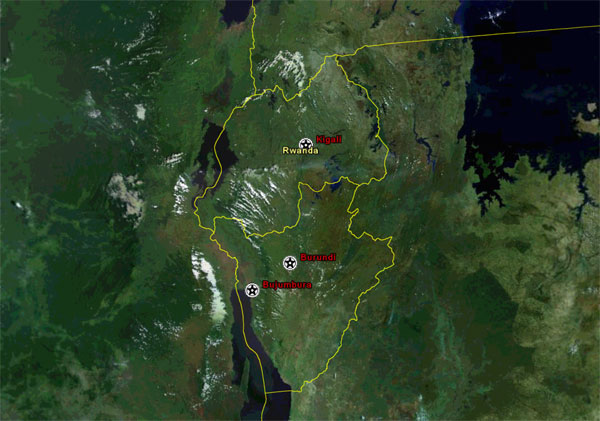
Image copyright Google Earth, MDA EarthSet, DigitalGlobe 2005
CIA-World Factbook Profile
FAO-Forestry Profile
World Resources Institute
Last updated: 4 Feb 2006