
FRENCH GUIANA
Please note, this page is not longer being updated. For more recent information, please see news.mongabay.com and use the search function to find the country feed. For more up-to-date data on forest cover and loss, check out Global Forest Watch.
| French Guiana Forest Figures
Forest Cover Total forest area: 8,063,000 ha % of land area: 91.8% Primary forest cover: 7,701,000 ha % of land area: 87.7% % total forest area: 95.5% Deforestation Rates, 2000-2005 Annual change in forest cover: n/a Annual deforestation rate: n/a Change in defor. rate since '90s: -100.0% Total forest loss since 1990: -28,000 ha Total forest loss since 1990:-0.3% Primary or "Old-growth" forests Annual loss of primary forests: -12000 ha Annual deforestation rate: -0.2% Change in deforestation rate since '90s: -17.4% Primary forest loss since 1990: -60,000 ha Primary forest loss since 1990:-2.6% Forest Classification Public: 99.8% Private: 0.2% Other: 0% Use Production: 0% Protection: 0% Conservation: 4% Social services: 0% Multiple purpose: 31.5% None or unknown: 64.4 Forest Area Breakdown Total area: 8,063,000 ha Primary: 7,701,000 ha Modified natural: 361,000 ha Semi-natural: n/a Production plantation: 1,000 ha Production plantation: n/a Plantations Plantations, 2005: 1,000 ha % of total forest cover: n.s.% Annual change rate (00-05): n/a Carbon storage Above-ground biomass: n/a M t Below-ground biomass: n/a M t Area annually affected by Fire: n/a Insects: n/a Diseases: n/a Number of tree species in IUCN red list Number of native tree species: 1,200 Critically endangered: 3 Endangered: 2 Vulnerable: 11 Wood removal 2005 Industrial roundwood: 70,000 m3 o.b. Wood fuel: n/a Value of forest products, 2005 Industrial roundwood: $2,716,000 Wood fuel: n/a Non-wood forest products (NWFPs): $4,099,000 Total Value: $6,815,000 More forest statistics for French Guiana |
For the immediate future, the forests of French Guiana face relatively few threats, although timber extraction is increasing and a relatively high population growth rate of displaced Lao farmers and other local groups may pressure coastal forest regions with subsistence agriculture. Gold potential in the interior regions is attracting foreign development interest, and there are some concerns over a potential road project. In recent years sporadic outbreaks of civil disorder over independence have brought into question what would happen to forests should French Guiana become independent. Still, the country lost only 2.6 percent of its forest cover between 1990 and 2005, the lowest loss in South America. Average annual deforestation rates have actually declined by 17 percent since the close of the 1990s.
Overall, more than 90 percent of French Guiana is forested, about 95 percent of which consists of primary forest. The country has some 1,064 known species of amphibians, birds, mammals and reptiles, according to figures from the World Conservation Monitoring Centre. Of these, 1.1 percent are endemic and 1.9 percent are threatened. French Guiana is home to at least 5,625 species of vascular plants, of which 2.6 percent are endemic. At present, 15.4 percent of French Guiana is protected under IUCN categories I-V.
Recent articles | French Guiana news updates | XML
Suggested reading - Books
- Mammals of the Neotropics, Volume 1 : The Northern Neotropics: Panama, Colombia, Venezuela, Guyana, Suriname, French Guiana (Eisenberg, John F//Mammals of the Neotropics)
- Space in the Tropics: From Convicts to Rockets in French Guiana
- French Guiana Map
- Guide to the Vascular Plants of Central French Guiana: Pteridophytes, Gymnosperms, and Monocotyledons (Memoirs of the New York Botanical Garden)
Unless otherwise specified, this article was written by Rhett A. Butler [Bibliographic citation for this page]
Other resources
Contact me if you have suggestions on other rainforest-related environmental sites and resources for this country.
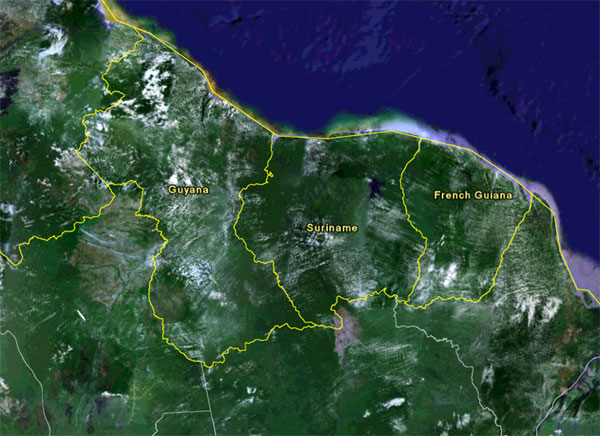
Image copyright Google Earth, MDA EarthSet, DigitalGlobe 2005
CIA-World Factbook Profile
Last updated: 6 Feb 2006