
GAMBIA
Please note, this page is not longer being updated. For more recent information, please see news.mongabay.com and use the search function to find the country feed. For more up-to-date data on forest cover and loss, check out Global Forest Watch.
| Gambia Forest Figures
Forest Cover Total forest area: 471,000 ha % of land area: 41.7% Primary forest cover: n/a % of land area: n/a % total forest area: n/a Deforestation Rates, 2000-2005 Annual change in forest cover: 2,000 ha Annual deforestation rate: 0.4% Change in defor. rate since '90s: 0.9% Total forest loss since 1990: 29,000 ha Total forest loss since 1990:6.6% Primary or "Old-growth" forests Annual loss of primary forests: n/a Annual deforestation rate: n/a Change in deforestation rate since '90s: n/a Primary forest loss since 1990: n/a Primary forest loss since 1990:n/a Forest Classification Public: 100% Private: n.s.% Other: 0% Use Production: n/a Protection: n/a Conservation: n/a Social services: n/a Multiple purpose: 100% None or unknown: n/a Forest Area Breakdown Total area: 471,000 ha Primary: n/a Modified natural: 471,000 ha Semi-natural: n/a Production plantation: n/a Production plantation: n/a Plantations Plantations, 2005: n/a % of total forest cover: 0.1% Annual change rate (00-05): n/a Carbon storage Above-ground biomass: 53 M t Below-ground biomass: 13 M t Area annually affected by Fire: 150,000 ha Insects: n/a Diseases: 100,000 ha Number of tree species in IUCN red list Number of native tree species: 140 Critically endangered: 0 Endangered: 0 Vulnerable: 0 Wood removal 2005 Industrial roundwood: 154,000 m3 o.b. Wood fuel: 718,000 m3 o.b. Value of forest products, 2005 Industrial roundwood: n/a Wood fuel: n/a Non-wood forest products (NWFPs): n/a Total Value: n/a More forest statistics for Gambia |
In the past five years the situation in Gambia has changed. FAO figures show a net increase in forest cover, likely resulting from increased plantations. Nevertheless, Gambia no longer has any intact primary forests.
According to the World Resources Institute, 3.2 percent of Gambia's land area is under some form of protection. The country is home to 974 species of plants, 117 mammals, and 535 birds.
Suggested reading - Books
Unless otherwise specified, this article was written by Rhett A. Butler [Bibliographic citation for this page]
Other resources
Contact me if you have suggestions on other rainforest-related environmental sites and resources for this country.
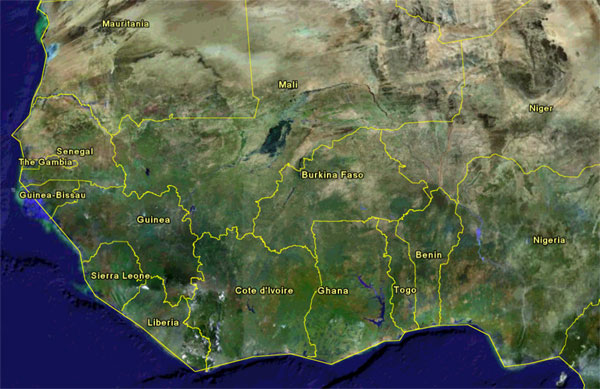
Image copyright Google Earth, MDA EarthSet, DigitalGlobe 2005
CIA-World Factbook Profile
FAO-Forestry Profile
World Resources Institute Profile (PDF)
Last updated: 4 Feb 2006