
GUINEA-BISSAU
Please note, this page is not longer being updated. For more recent information, please see news.mongabay.com and use the search function to find the country feed. For more up-to-date data on forest cover and loss, check out Global Forest Watch.
| Guinea-Bissau Forest Figures
Forest Cover Total forest area: 2,072,000 ha % of land area: 73.7% Primary forest cover: 940,000 ha % of land area: 33.4% % total forest area: 45.4% Deforestation Rates, 2000-2005 Annual change in forest cover: -9,600 ha Annual deforestation rate: -0.5% Change in defor. rate since '90s: 4.5% Total forest loss since 1990: -144,000 ha Total forest loss since 1990:-6.5% Primary or "Old-growth" forests Annual loss of primary forests: n/a Annual deforestation rate: n/a Change in deforestation rate since '90s: n/a Primary forest loss since 1990: n/a Primary forest loss since 1990:0.0% Forest Classification Public: 84.2% Private: 15.8% Other: 0% Use Production: 39.6% Protection: 11.7% Conservation: 45.4% Social services: 3.4% Multiple purpose: n/a None or unknown: n/a Forest Area Breakdown Total area: 2,072,000 ha Primary: 940,000 ha Modified natural: 1,132,000 ha Semi-natural: n/a Production plantation: n/a Production plantation: n/a Plantations Plantations, 2005: 1,000 ha % of total forest cover: n.s.% Annual change rate (00-05): 34,000 ha Carbon storage Above-ground biomass: 98 M t Below-ground biomass: 24 M t Area annually affected by Fire: 30,000 ha Insects: n/a Diseases: n/a Number of tree species in IUCN red list Number of native tree species: 2,243 Critically endangered: 0 Endangered: 0 Vulnerable: 4 Wood removal 2005 Industrial roundwood: 32,000 m3 o.b. Wood fuel: 1,385,000 m3 o.b. Value of forest products, 2005 Industrial roundwood: $2,000,000 Wood fuel: $15,000,000 Non-wood forest products (NWFPs): n/a Total Value: $17,000,000 More forest statistics for Guinea-Bissau |
About 1,000 plants species are known to exist in Guinea-Bissau. The country is also home to 108 species of mammals, 459 species of birds, and 110 types of freshwater fish.
While Guinea-Bissau's net deforestation rate is relatively low at 0.5 percent per year between 2,000 and 2,005, there is concern about increasing development, especially in a new era of relative political stability. In particular, coastal mangrove swamps—some of the most important in Africa—are giving way to rice fields and hydroelectric projects. Slash-and-burn agriculture, coal production, fires, fuelwood cutting, and logging for timber have resulted in forest loss and subjected Guinea-Bissau to serious soil degradation and erosion in some areas. Hunting and poaching threaten wildlife in virtually all areas.
Suggested reading - Books
Unless otherwise specified, this article was written by Rhett A. Butler [Bibliographic citation for this page]
Other resources
Contact me if you have suggestions on other rainforest-related environmental sites and resources for this country.
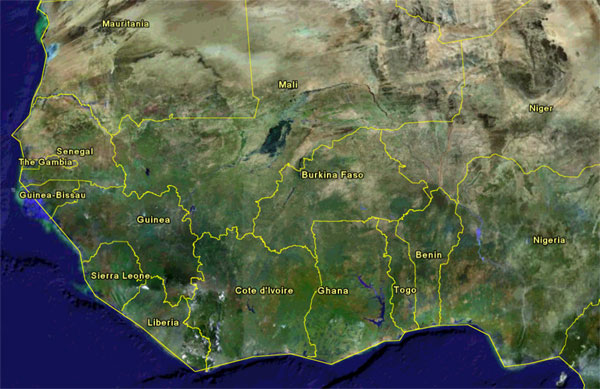
Image copyright Google Earth, MDA EarthSet, DigitalGlobe 2005
CIA-World Factbook Profile
FAO-Forestry Profile
World Resources Institute
Last updated: 4 Feb 2006