TROPICAL RAINFORESTS
 Home
 What's New
 About
 Rainforests
   Mission
   Introduction
   Characteristics
   Biodiversity
   The Canopy
   Forest Floor
   Forest Waters
   Indigenous People
   Deforestation
   Consequences
   Saving Rainforests
   Amazon rainforest
   Borneo rainforest
   Congo rainforest
   Country Profiles
   Statistics
   Works Cited
   For Kids
   For Teachers
   Photos/Images
   Expert Interviews
   Rainforest News
  Forest data
   Global deforestation
   Tropical deforestation
   By country
   Deforestation charts
   Regional forest data
   Deforestation drivers
 XML Feeds
 Other Languages
   Chinese
   French
   German
   Japanese
   Portuguese
   Spanish
 Pictures
 Books
 Links
 Newsletter
 Education
 Mongabay Sites
   Kids' site
   Travel Tips
   Tropical Fish
   Madagascar
 Contact


About this site
Providing tropical forest news, statistics, photos, and information, rainforests.mongabay.com is the world's most popular rainforest site. [more]


Weekly Newsletter
Enter your email:
Mongabay will never distribute your email address or send spam.


Share


GUYANA

Guyana Forest Figures

Forest Cover
Total forest area: 15,104,000 ha
% of land area: 76.7%

Primary forest cover: 9,314,000 ha
% of land area: 47.3%
% total forest area: 61.7%

Deforestation Rates, 2000-2005
Annual change in forest cover: n/a
Annual deforestation rate: n/a
Change in defor. rate since '90s: n/a
Total forest loss since 1990: n/a
Total forest loss since 1990:0.0%

Primary or "Old-growth" forests
Annual loss of primary forests: n/a
Annual deforestation rate: n/a
Change in deforestation rate since '90s: n/a
Primary forest loss since 1990: n/a
Primary forest loss since 1990:n/a

Forest Classification
Public: 66.3%
Private: n/a
Other: 33.7%
Use
Production: 34.9%
Protection: n/a
Conservation: 1%
Social services: 2.4%
Multiple purpose: n/a
None or unknown: 61.7

Forest Area Breakdown
Total area: 15,104,000 ha
Primary: 9,314,000 ha
Modified natural: 5,789,000 ha
Semi-natural: n/a
Production plantation: n/a

Plantations
Plantations, 2005: n/a
% of total forest cover: n/a
Annual change rate (00-05): n/a

Carbon storage
Above-ground biomass: 2,824 M t
Below-ground biomass: 619 M t

Area annually affected by
Fire: n/a
Insects: n/a
Diseases: n/a

Number of tree species in IUCN red list
Number of native tree species: 1,182
Critically endangered: 1
Endangered: 3
Vulnerable: 18

Wood removal 2005
Industrial roundwood: n/a
Wood fuel: n/a

Value of forest products, 2005
Industrial roundwood: n/a
Wood fuel: n/a
Non-wood forest products (NWFPs): n/a
Total Value: n/a


More forest statistics for Guyana

Guyana is a small, lightly populated country on the north coast of South America. About three-quarters of Guyana is forested, roughly 60 percent of which is classified as primary forest. Guyana's forests are highly diverse: the country has some 1,263 known species of amphibians, birds, mammals, and reptiles, and 6,409 species of plants. According to an assessment by the ITTO, forests in Guyana can be broken down as follows: rainforest (36 percent), montane forest (35 percent). swamp and marsh (15 percent), dry evergreen (7 percent), seasonal forest (6 percent), and mangrove forest (1 percent).

Despite its forest cover, Guyana's ancient soils are highly infertile and most of the country's population of 765,000 is confined to coastal areas. Guyana is one of South America's poorest countries and carries an external debt that is 40 percent of its GDP.

Logging

Historically, Guyana's extensive forests have been lightly exploited, largely due to obsolete equipment and lack of capital, but in the early 1990s the government began to make overtures toward foreign logging firms to harvest the country's "slow growing" and "heavy" hardwoods (ITTO) like greenheart (Chlorocardium rodiaei). Encouraged by the International Monetary Fund (IMF) and the World Bank to maximize development of its resources to attract foreign investment, in 1991 the ruling strongman granted a 50-year, 4.2-million-acre (1.69-million-hectare) concession to Barama Company Limited, a Malaysian-Korean logging firm. Under the terms of the deal, Barama enjoyed a 10-year tax holiday, paid almost no royalties to the Guyana government, and was granted the right to log lands that had been inhabited by indigenous groups. With such favorable agreements, logging firms soon flooded to Guyana, which had some of the lowest logging fees and royalties in the world—only 10 percent of what most African and Asian countries charged at the time. At the same time illegal chainsaw logging expanded rapidly, and Guyana lost control over its forestry sector.

In reaction to the sudden invasion of foreign logging firms and in order to receive a loan, in May of 1995, the government issued a three-year moratorium on new logging concessions. Shortly thereafter, the government enacted environmental legislation and took steps to regain some semblance of control over the timber industry. With aid from international groups, the Guyanese government increased funding for its forestry commission to better monitor logging activities. According to the ITTO, the current forestry law includes a provision for a "conservation concession in which an opportunity value of fee revenue is paid in lieu of harvesting revenues." Thus timber companies can be compensated for leaving an area of forest untouched by logging.

For its part, Barama claims to be carrying out sustainable forestry and maintains that it only extracts two trees per acre, while minimizing damage to the surrounding forest. Its operations are monitored by an independent research center that carries out studies to assess growth rates and logging impacts. With such a plan, the forest could, in theory, regenerate in 25 years. Barama says that it plans to stay in Guyana for its full 50-year concession.

Today the level of harvesting in Guyana is very low. According to estimates from the FAO and the ITTO, harvesting is probably 350,000-400,000 cubic meters per year from an area of 6 million hectares. Commercial logging is presently limited by lack of infrastructure and high harvesting costs, political uncertainties, and the dispersal of valuable tree stocks over a wide area.

This is ITTO's assessment of the timber sector in Guyana:
    Unlike most other advice given, the mission does not believe that pursuit of high volume and creation of competitive, integrated enterprises are the correct way forward. Guyana has a diverse forest resource with small quantities of unusual species. It cannot dry and process timber to a moisture content suitable for indoor use in centrally heated buildings in temperate countries. Although there are decorative woods and greenheart, much of the resource is hard, heavy, and dark.

    Capital is expensive and extremely limited and therefore has to be used optimally, which means operating at the cheapest scale. Capacity for different processes may not be sufficiently compatible for a single enterprise to operate them all optimally. This suggests that specialization would be a better strategy than vertical integration for most enterprises.

    Returns to Guyana from its forests will have to come through maximizing both added value and employment opportunities. The current tendency to export logs, especially at an average price of just over US$60/cubic meter, helps neither of these goals.
In its 2003 survey, the ITTO concluded that "there were relatively few negative impacts associated with forest harvesting in Guyana. This is not to say there are no problems but there are certainly no major ones. Negative impacts are almost certainly arising from increased chainsaw logging, especially on wildlife, but there is no objective measurement of these."

Mining

Mining is one of Guyana's most important economic activities—sugar, bauxite, rice, and gold account for 70-75 percent of export earnings, according to the WTO.

Gold mining in Guyana made international headlines in August of 1995 when a mine run by Golden Star Resources (Denver, U.S.) and Cambior (Montreal, Canada) spilled four billion liters of cyanide-laced waste water into a tributary of the Essequibo, Guyana's largest river. Initially, mine operators tried to cover up the spill by burying fish carcasses, but eventually they reported the spill to the Guyanese government six days after the fact.

The ITTO reports that mining (mainly gold but also gems including diamonds), particularly small-scale operations, is having significant environmental impacts in Guyana. Mining has resulted in widespread deforestation in the upper Essequibo region while mine tailings—including mercury and cyanide—end up in local waterways. The ITTO notes that "in Mahdia, where the population probably has one of the highest per capita supplies in the world of fresh water from the rainfall, the community has no access to a supply of potable water."

With gold prices currently hovering on the high side of their historical range it seems likely that gold exploitation will continue to expand in Guyana.

Overall deforestation

Deforestation rates are presently unavailable for Guyana, but they are likely low. In the first half of the 1990s, FAO figures show that Guyana lost about 0.3 percent of its forest cover annually, one of the lowest rates in South America.

Conservation and the Environment

To date only 2.3 percent of Guyana is protected, though Conservation International has secured some 300,000 hectares of forest in two "conservation concessions." With its virgin forests and the magnificent 425-foot King George VI falls, the country has excellent potential for eco-tourism.

Recent articles | Guyana news updates | XML

Norway to give Guyana up to $250M for rainforest conservation
(11/09/2009) Norway will provide up to $250 million to Guyana as part of the South American country's effort to avoid emissions from deforestation.


Roads are enablers of rainforest destruction
(09/24/2009) Chainsaws, bulldozers, and fires are tools of rainforest destruction, but roads are enablers. Roads link resources to markets, enabling loggers, farmers, ranchers, miners, and land speculators to convert remote forests into economic opportunities. But the ecological cost is high: 95 percent of deforestation in the Brazilian Amazon occurs within 50-kilometers of a road; in Africa, where logging roads are rapidly expanding across the Congo basin, the bulk of bushmeat hunting occurs near roads. In Laos and Sumatra, roads are opening last remnants of intact forests to logging, poaching, and plantation development. But roads also cause subtler impacts, fragmenting habitats, altering microclimates, creating highways for invasive species, blocking movement of wildlife, and claiming animals as roadkill. A new paper, published in Trends in Evolution and Ecology, reviews these and other impacts of roads on rainforests. Its conclusions don't bode well for the future of forests.


REDD readiness plans for Panama, Guyana approved but rejected for Indonesia
(07/02/2009) The World Bank's Forest Carbon Partnership Facility (FCPF) has approved REDD readiness plans (R-Plans) for Panama and Guyana, and rejected a plan for Indonesia, reports the U.N. and the Bank Information Center, an advocacy group.


Norway emerges as champion of rainforest conservation
(03/19/2009) While citizens in western countries have long paid lip service to saving rainforests, Norway has quietly emerged as the largest and most important international force in tropical forest conservation. The small Scandinavian country has committed 3 billion krone ($440 million) a year to the effort, a figure vastly greater than the $100M pledged — but never fully contributed — by the United States under the Tropical Forest Conservation Act (TFCA). Norway now hopes it can help push to include forest conservation in the successor to the Kyoto Protocol by providing funding and fostering cooperation among international actors like the UN and World Bank, as well as developing countries, to fund the creation of an international architecture which makes it possible to incorporate deforestation and degradation into a post-2012 climate regime.


Amazon rainforest in big trouble, says UN
(02/19/2009) Economic development could doom the Amazon warns a comprehensive new report from the United Nations Environment Programme (UNEP). The report — titled GEO Amazonia [PDF-21.3MB] — is largely a synthesis of previously published research, drawing upon studies by more than 150 experts in the eight countries that share the Amazon.


Payments for eco services could save the Amazon
(02/12/2009) Paying for the ecological services provided by the Amazon rainforest could be the key to saving it, reports a new analysis from WWF. The study, Keeping the Amazon forests standing: a matter of values, tallied the economic value of various ecosystem services afforded by Earth's largest rainforest. It found that standing forest is worth, at minimum, $426 per hectare per year.


Norway to pay Guyana to save its rainforests
(02/05/2009) Norway will provide financial support for Guyana's ambitious plan to conserve its rainforests, reports the Guyana Chronicle. Meeting in Oslo, Norway on Tuesday, Guyana President Bharrat Jagdeo and Norwegian Prime Minister Jens Stoltenberg signed a Memorandum of Understanding agreeing to establish a partnership to reduce greenhouse gas emissions from deforestation and forest degradation (REDD). The leaders will push for the incorporation of a REDD mechanism that includes low deforestation countries like Guyana in a post-2012 climate change agreement.


Markets could save rainforests: an interview with Andrew Mitchell
(08/17/2008) Markets may soon value rainforests as living entities rather than for just the commodities produced when they are cut down, said a tropical forest researcher speaking in June at a conservation biology conference in the South American country of Suriname. Andrew Mitchell, founder and director of the London-based Global Canopy Program (GCP), said he is encouraged by signs that investors are beginning to look at the value of services afforded by healthy forests.


14 countries win REDD funding to protect tropical forests
(07/24/2008) Fourteen countries have been selected by the World Bank to receive funds for conserving their tropical forests under an innovative carbon finance scheme.


600 species of mushrooms discovered in Guyana
(07/21/2008) In six plots of Guyanese rainforest, measuring only a hundred square meters each, scientists have discovered an astounding 1200 species of macrofungi, commonly known as mushrooms. Even more surprising: they believe over 600 of these are new to science — that's equivalent to a new species every square meter.


Implementing a butterfly farm: Iwokrama reserve's latest sustainable initiative
(07/20/2008) Iwokrama, which lies in the heart of Guyana's rainforest, is known worldwide for its innovative approach to preserving tropical rainforests and creating livelihoods for local communities. Their focus has been to create programs that utilize the forest sustainably, allowing for a mutual benefit between the people and the forest itself. Currently, Iwokrama has a number of initiatives under its umbrella, including eco-tourism, sustainable forestry, on-going research projects, and training programs. Amid these bustling projects, a new one has emerged: butterfly farming.


Geology, climate links make Guiana Shield region particularly sensitive to change
(06/14/2008) Soil and climate patterns in the Guiana Shield make the region particularly sensitive to environmental change, said a scientist speaking at a biology conference in Paramaribo, Suriname.


Rare golden primates help speed recovery of endangered Brazilian forest
(06/09/2008) The endangered golden lion tamarin — a flagship species for conservation efforts in Brazil's highly threatened Atlantic Forest or Mata Atlantica — plays an important role in seed dispersal, thereby helping forest regeneration, according to research published in the June issue of the open access e-journal Tropical conservation Science.


Guiana Shield forests help preserve biodiversity and climate
(06/09/2008) The Guiana Shield region of South America could play a significant role in efforts to fight global warming as part of a broader strategy to protect the world's biodiversity hotspots and high biodiversty wilderness areas, said a leading conservationist speaking in Paramaribo, Suriname at a gathering of tropical biologists.


Investing to save rainforests
(04/02/2008) Last week London-based Canopy Capital, a private equity firm, announced a historic deal to preserve the rainforest of Iwokrama, a 371,000-hectare reserve in the South American country of Guyana. In exchange for funding a "significant" part of Iwokrama's $1.2 million research and conservation program on an ongoing basis, Canopy Capital secured the right to develop value for environmental services provided by the reserve. Essentially the financial firm has bet that the services generated by a living rainforest — including rainfall generation, climate regulation, biodiversity maintenance and carbon storage — will eventually be valuable in international markets. Hylton Murray-Philipson, director of Canopy Capital, says the agreement — which returns 80 percent of the proceeds to the people of Guyana — could set the stage for an era where forest conservation is driven by the pursuit of profit rather than overt altruistic concerns.


Private equity firm buys rights to ecosystem services of Guyana rainforest
(03/27/2008) A private equity firm has purchased the rights to environmental services generated by 371,000 hectare rainforest reserve in Guyana. Terms of the deal were not disclosed, but the agreement is precedent-setting in that a financial firm is betting that the services generated by a living rainforest — including rainfall generation, climate regulation, biodiversity maintenance and water storage — will eventually see compensation in international markets.


Is Guyana's logging deal in its best interests?
(02/21/2008) In January Guyana awarded U.S. timber firm Simon & Shock International a 400,000-hectare (988,400-acre) logging concession near the Brazilian border. Final approval hinges on the completion of an environmental impact survey and a tree inventory. While Simon & Shock International says it plans to conduct selective logging, the firm has not announced whether it will seek Forest Stewardship Council certification, a mark for responsibly-harvested timber. Is there an alternative that can improve the lot for the average Guyanese? There may be. Last fall Guyana's President, Bharrat Jagdeo, hinted at the potential of using the country's forests as a giant carbon offset to counter climate change.


Malaysian timber firm fined for illegal rainforest logging in Guyana
(01/21/2008) Barama Company Limited, a subsidiary of the Samling Group, a Malaysian logging firm, has been fined for violating Guyana's forest laws, reports Staebroek News. Barama operates the largest timber concession in Guyana.


Guyana grants 1 million acres of Amazon rainforest to U.S. logging firm
(01/09/2008) Guyana has awarded a 988,4000-acre logging concession to a U.S. forestry company, reports the Associated Press.


Guyana's forests offered as massive carbon offset
(11/26/2007) Guyana has offered up the entirity of its remaining forest cover as a giant carbon offset, reports The Independent.


Amphibian extinction may be worse than thought
(10/31/2007) Amphibian extinction rates may be higher than previously thought, according to new DNA analysis that found more than 60 unrecognized species in the Guiana Shield of South America.


Rainforest tribe establishes massive sustainable-use reserve
(10/04/2007) An indigenous group in Guyana has established one of the world's largest sustainable forest reserves, reports conservation International.


Low deforestation countries to see least benefit from carbon trading
(08/13/2007) Countries that have done the best job protecting their tropical forests stand to gain the least from proposed incentives to combat global warming through carbon offsets, warns a new study published in Tuesday in the journal Public Library of Science Biology (PLoS). The authors say that "high forest cover with low rates of deforestation" (HFLD) nations "could become the most vulnerable targets for deforestation if the Kyoto Protocol and upcoming negotiations on carbon trading fail to include intact standing forest."


China tropical log imports jump at Jiangsu port
(05/16/2007) Logs imports through Zhangjiagang Port in Jiangsu Province, China have increased significantly in 2007, reports the International Tropical Timber Organization (ITTO) in its bi-weekly update.


Amazon rainforest fires date back thousands of years
(03/14/2007) Fires are nothing new to the Amazon reports a study published in the journalBiotropica. Analyzing soils in the eastern Amazon, a team of scientists led by David S. Hammond of NWFS Consulting, has found evidence of forest fires dating back thousands of years. While the origin of these fires is unclear, the authors propose intriguing scenarios involving pre-Colombian human populations and ancient el Nino events which could have so dried rainforest areas that they became more prone to forest fires.


Suggested reading - Books


Unless otherwise specified, this article was written by Rhett A. Butler [Bibliographic citation for this page]

Other resources

Contact me if you have suggestions on other rainforest-related environmental sites and resources for this country.
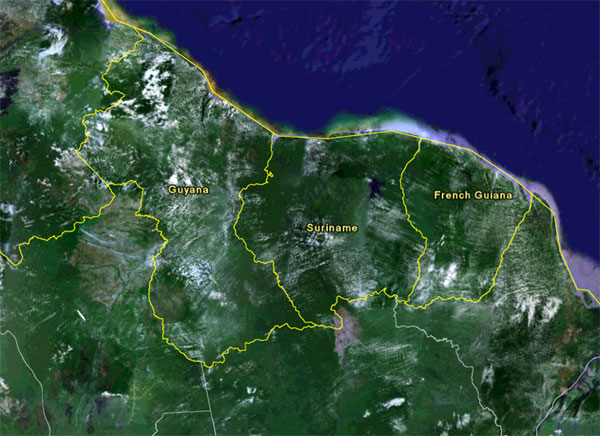

Image copyright Google Earth, MDA EarthSet, DigitalGlobe 2005

CIA-World Factbook Profile
FAO-Forestry Profile
ITTO: sustainable forest management in Guyana (.doc)


Last updated: 7 Feb 2006


what's new | rainforests home | for kids | help | madagascar | search | about | languages | contact

Copyright Rhett Butler 1994-2009