TROPICAL RAINFORESTS
 Home
 What's New
 About
 Rainforests
   Mission
   Introduction
   Characteristics
   Biodiversity
   The Canopy
   Forest Floor
   Forest Waters
   Indigenous People
   Deforestation
   Consequences
   Saving Rainforests
   Amazon rainforest
   Borneo rainforest
   Congo rainforest
   Country Profiles
   Statistics
   Works Cited
   For Kids
   For Teachers
   Photos/Images
   Expert Interviews
   Rainforest News
  Forest data
   Global deforestation
   Tropical deforestation
   By country
   Deforestation charts
   Regional forest data
   Deforestation drivers
 XML Feeds
 Other Languages
   Chinese
   French
   German
   Japanese
   Portuguese
   Spanish
 Pictures
 Books
 Links
 Newsletter
 Education
 Mongabay Sites
   Kids' site
   Travel Tips
   Tropical Fish
   Madagascar
 Contact


About this site
Providing tropical forest news, statistics, photos, and information, rainforests.mongabay.com is the world's most popular rainforest site. [more]


Weekly Newsletter
Enter your email:
Mongabay will never distribute your email address or send spam.


Share


KENYA

Kenya Forest Figures

Forest Cover
Total forest area: 3,522,000 ha
% of land area: 6.2%

Primary forest cover: 704,000 ha
% of land area: 1.2%
% total forest area: 20.0%

Deforestation Rates, 2000-2005
Annual change in forest cover: -12,000 ha
Annual deforestation rate: -0.3%
Change in defor. rate since '90s: -1.4%
Total forest loss since 1990: -186,000 ha
Total forest loss since 1990:-5.0%

Primary or "Old-growth" forests
Annual loss of primary forests: -2400 ha
Annual deforestation rate: -0.3%
Change in deforestation rate since '90s: -4.3%
Primary forest loss since 1990: -12,000 ha
Primary forest loss since 1990:-5.1%

Forest Classification
Public: 97.8%
Private: 2.2%
Other: 0%
Use
Production: n.s.%
Protection: 100%
Conservation: n/a
Social services: n/a
Multiple purpose: n/a
None or unknown: n/a

Forest Area Breakdown
Total area: 3,522,000 ha
Primary: 704,000 ha
Modified natural: 2,616,000 ha
Semi-natural: n/a
Production plantation: 202,000 ha
Production plantation: n/a

Plantations
Plantations, 2005: 202,000 ha
% of total forest cover: 5.7%
Annual change rate (00-05): -2,000,000 ha

Carbon storage
Above-ground biomass: 536 M t
Below-ground biomass: 133 M t

Area annually affected by
Fire: 3,000 ha
Insects: n/a
Diseases: n/a

Number of tree species in IUCN red list
Number of native tree species: n/a
Critically endangered: 3
Endangered: 14
Vulnerable: 50

Wood removal 2005
Industrial roundwood: 2,402,000 m3 o.b.
Wood fuel: 24,256,000 m3 o.b.

Value of forest products, 2005
Industrial roundwood: n/a
Wood fuel: n/a
Non-wood forest products (NWFPs): n/a
Total Value: n/a


More forest statistics for Kenya

Kenya has very little rainforest (mostly montane forest) cover, and these scattered patches are being further degraded for fuelwood and building material. Overall forest loss in Kenya has been moderate over the past generation—5 percent of the country's forest cover was lost between 1990 and 2005. Primary forest cover also fell by 5 percent over the same period and now cover around 700,000 hectares. Deforestation rates have decreased slightly since the end of the 1990s.

Kenya is world famous for its safari wildlife, and 12.3 percent of its land area is currently under some form of protection. The country has 1,103 species of birds, 261 mammals, 407 reptiles, 76 amphibians, and 6,500 species of plants.

The most immediate threats to Kenya's forests are subsistence activities and agricultural expansion. In recent years conflicts between forest squatters and police have escalated as the government tries to crack down on deforestation. In 2005, the government evicted 10,000-50,000 families from the edge of the Mau Forest in the Rift Valley as part of its campaign to protect the country's natural resources.

Recent articles | Kenya news updates | XML

NASA satellite image reveals extent of drought in East Africa
(11/05/2009) A new image from NASA shows the severity of the drought in East Africa, which impacted Tanzania, Kenya, Ethiopia, and Somalia.


Tsavo lions ate 35 people, not 135
(11/02/2009) A recent study in the Proceedings of the National Academy of Sciences has shown that the two man-killing lions of Tsavo very likely did not kill and eat as many people as claimed. Looking at hair and bone samples from the pair of male lions, now resting in the Chicago Field Museum, researchers were able to determine that the Tsavo lions likely killed and ate approximately 35 people, not 135 as claimed by Lieutenant Colonel John H. Patterson. Patterson became famous for shooting and killing the lions in December 1898. For nine months the two lions terrorized a railroad camp in Kenya.


Kenya's pain, part two: decades of wildlife decline exacerbated by drought
(10/20/2009) Not many years ago if you were planning a trip to Africa to see wildlife, Kenya would be near the top of the list, if not number one. Then violent riots in late 2007 and early 2008 leaving a thousand dead tarnished the country's image abroad. When calm and stability returned, Kenya was again open for tourism, and it's true that most travelers were quick to forget: articles earlier this year announced that even with the global economic crisis Kenya was expecting tourism growth. However, a new disaster may not be so quickly overcome.


Employing dogs to save endangered species and places, an interview with Megan Parker
(09/21/2009) For millennia dogs have been helpers to humans: they have herded and protected livestock, pulled sleds, hunted game, led the blind, located people after disasters, and sniffed out drugs. Now a new occupation can be added: conservation aide. Working Dogs for Conservation (WDC) was begun by Megan Parker in 2000: the idea, to use dogs' impeccable scent capabilities for conservation initiatives, appears so logical and useful when Parker talks about it, one is surprised it took environmentalists so long to realize the potential of dogs.


Kenya's pain: famine, drought, government ambivalence cripples once stable nation
(09/17/2009) Kenya was once considered one of Sub-Saharan Africa's success stories: the country possessed a relatively stable government, a good economy, a thriving tourist industry due to a beautiful landscape and abundant wildlife. But violent protests following a disputed election in 2007 hurt the country's reputation, and then—even worse—drought and famine struck the country this year. The government response has been lackluster, the international community has been distracted by the economic crisis, and suddenly Kenya seems no longer to be the light of East Africa, but a warning to the world about the perils of ignoring climate change, government corruption, and the global food and water shortages.


Community engagement is key to saving the rarest zebra
(09/14/2009) Efforts to protect the world's largest and rarest species of zebra — Grévy's Zebra (Equus grevyi) — hinge on engaging communities to lead conservation in their region, says a Kenyan conservationist. Belinda Low, Executive Director of the Nairobi-based Grevy's Zebra Trust, says her group's programs, which employ members of local communities as scouts and conservation workers, are helping maintain dialog between communities while providing new opportunities for education and employment. Grevy's Zebra Trust is working with communities to plan livestock grazing so that it can be used as a tool to replenish the land, rather than degrade it


Solar powered conservation
(08/25/2009) Electricity can be a difficult commodity to procure in the remote areas where conservationists often work. Typically field researchers and wildlife rangers rely on gas-powered generators, which require imported fuel, often produce noxious fumes and disruptive noise, and can be costly to maintain. A better option, especially in sun-drenched parts of the world, is solar. Clean and silent, with no need for supplemental fuel, solar seems like an ideal fit for conservation work except for one major drawback: cost. But Stephen Gold – Solar and Technology Manager for Wildlife Conservation Network has been working to overcome that obstacle.


Lion population in Kenya could disappear in 10 to 20 years
(08/20/2009) The Kenyan Wildlife Service recently announced that massive declines in lion population may lead to their disappearence from the region within less than 2 decades. Kenya currently has an estimated 2000 lions, but is losing the large cats at a rate of around 100 each year.


Economic crisis threatens conservation programs and endangered species, an interview with Paula Kahumbu of WildlifeDirect
(08/17/2009) Founded in 2004 by legendary conservationist Richard Leakey, WildlifeDirect is an innovative member of the conservation community. WildlifeDirect is really a meta-organization: it gathers together hundreds of conservation initiatives who blog regularly about the trials and joys of practicing on-the-ground conservation. From stories of gorillas reintroduced in the wild to tracking elephants in the Okavango Delta to saving sea turtles in Sumatra, WildlifeDirect provides the unique experience of actually hearing directly from scientists and conservationists worldwide.


Kenya moves forward to ban the pesticide Furadan after it is used to kill 76 lions
(06/08/2009) After highly-publicized poisonings of lions in Kenya’s national parks, the Kenyan Parliament has begun addressing longstanding concerns regarding the pesticide Furadan. Since 1995 Furadan has been used to illegally kill 76 lions, 15 hyenas, 24 hippos, over 250 vultures, and thousands of other birds in Kenya. These numbers are likely low due to under-reporting, according to Kenya-based conservation organization, Wildlife Direct.


Famous elephant matriarch, Echo, dies from old age
(05/06/2009) Subject of several documentaries, Kenya’s most famous elephant, Echo, died last Sunday from old age, likely exasperated by drought conditions in East Africa.


Huge cache of smuggled ivory represents up to 40 elephants
(04/29/2009) On April 25th two men were pursued by wildlife rangers from the Amboseli-Tsavo Game Scouts Association in Tanzania. The men escaped across the border to southern Kenya where they were caught by police, who had been tipped off by the wildlife scouts. The two men’s SUV contained 1,550 lbs (703 kilograms) of elephant tusks, representing a total of up to forty individuals according to the Kenyan Wildlife Service. This is considered the largest seizure in the region since the ivory smuggling boom of the late 1970s and early 1980s. The ivory is estimated at a value of $750,000 (or 60 million Kenyan shillings).


Famous Kenyan park experiencing large declines in wildlife
(04/21/2009) In Masai Mara, one of Africa’s most treasured parks, researchers have found significant, in some cases catastrophic, declines of wild grazing animals. In fifteen years six of seven hoofed animals—giraffes, warthogs, hartebeest, impala, topis and waterbucks—showed declines. The study published in the British Journal of Zoology confirms what has long been expected: wildlife populations in Masai Mara are plummeting due to increased competition with humans and livestock.


Kenya signs its first REDD deal to conserve forests
(04/16/2009) Kenya has signed its first carbon deal to reduce emissions from deforestation and degradation (REDD).


Fire in Kenya threatens some of the world's most beloved parks
(03/24/2009) Started by arsonists, fires have swept through Kenya's Great Rift valley, home of some of the world's most treasured parks and ten million Kenyans already suffering from long-term drought.


All about giraffes: an interview with a giraffe expert
(03/09/2009) Dr. Julian Fennessy probably knows the giraffe better than anyone. Trekking across savannah, forest, and the deserts of Africa, Fennessy is collecting genetic samples of distinct giraffe populations and overturning common wisdom regarding their taxonomies. It had long been accepted knowledge that the giraffe was made up of one species and several subspecies, however with Fennessy's work it now appears that several of the subspecies may in fact be distinct species. Such discoveries could have large conservation impacts, since conservation funds and efforts are largely devoted to species. The giraffe has suffered significant declines in the past decade with the total population dropping some 30 percent across Africa.


How youth in Kenya's largest slum created an organic farm
(12/09/2008) Kibera is one of the world's largest slums, containing over a million people and 60 percent of Nairobi's population. With extremely crowded conditions, little sanitation, and an unemployment rate at 50 percent, residents of Kibera face not only abject poverty but also a large number of social ills, including drugs, alcoholism, rape, AIDS, water-borne diseases, and tensions between various Kenyan tribes.


IP laws not helping indigenous people protect traditional knowledge (repost)
(11/13/2008) Promoting capacity for self-governance rather than using conventional systems governing intellectual property rights may be a more effective way to safeguard traditional knowledge of indigenous groups, argues a new report published by an international team of IP experts. Released at an IP conference convened by Sciences Po, a French research institute, and The Innovation Partnership, a Canadian NGO, the report details how traditional knowledge is treated in Brazil, Kenya and Northern Canada. It finds significant differences in the effectiveness of IP laws and policies in protecting the wisdom and knowledge accumulated by indigenous communities.


First captive black rhinos released into the wild in 25 years
(10/03/2008) Fifteen critically-endangered black rhinos have been released at an undisclosed location in Kenya with hopes that this pioneer group will breed naturally, repopulating an area they once roamed abundantly. The release is the first time in 25 years that captive rhinos have been returned to the wild.


Cheetah population stabilizes in Namibia with support from farmers
(10/02/2008) Viewing the world's fastest land animal as a threat to their livestock, in the 1980s farmers killed half of Namibia's cheetah population. The trend continued into the early 1990s, when the population was diminished again by nearly half, leaving less than 2,500 cheetah in the southern African country. Today cheetah populations have stabilized due, in large part, to the efforts of the Cheetah Conservation Fund, an organization founded by Dr. Laurie Marker.


Kenyan community displaced by nature reserve seeks justice
(09/22/2008) Lake Bogoria is a fascinating nature reserve in Kenya's Rift Valley. Set in a strange arid landscape, the lake attracts tens of thousands of flamingos. The multitudes of bright pink birds contrast with the grayish-blue landscape. The lake itself is shallow and saline; boiling hot springs and geysers can be found along its western shore. Fish eagles and marabou storks haunt the waters, seeking out flamingo for dinner. Antelope, even the greater kudu, can sometimes be seen, while hyraxes make their homes in the surrounding bare rock. However, the strange beauty of this reserve comes with a grim reality not shown to tourists.


Group takes "venture capital" approach to conservation
(09/16/2008) An innovative group is using a venture capital model to save some of the world's most endangered species, while at the same time working to ensure that local communities benefit from conservation efforts. The Wildlife Conservation Network (WCN), an organization based in Los Altos, California, works to protect threatened species by focusing on what it terms "conservation entrepreneurs" -- people who are passionate about saving wildlife and have creative ideas for dong so. After a rigorous review process to identify and select projects that will have the greatest impact on conservation in developing countries, WCN provides the conservationist with fund-raising and back-office support, technology, and access to its network of people and resources.


Threatened forest in Kenya home to a diversity of bird life
(09/15/2008) The Tana River forest in coastal Kenya is home to a diverse array of bird species but is increasingly under threat from logging, agricultural expansion, and unsustainable harvesting of some bird species, reports a new study published in the open-access journal Tropical Conservation Science.


NASA study shows global warming will diminish rainfall in East Africa, worsening hunger
(08/06/2008) A new NASA-backed study has found a link between a warming Indian Ocean and reduced rainfall in eastern and southern Africa. The results suggest that rising sea temperatures could exacerbate food problems in some of the continent's most famine-prone regions.


14 countries win REDD funding to protect tropical forests
(07/24/2008) Fourteen countries have been selected by the World Bank to receive funds for conserving their tropical forests under an innovative carbon finance scheme.


Suggested reading - Books


Unless otherwise specified, this article was written by Rhett A. Butler [Bibliographic citation for this page]

Other resources

Contact me if you have suggestions on other rainforest-related environmental sites and resources for this country.
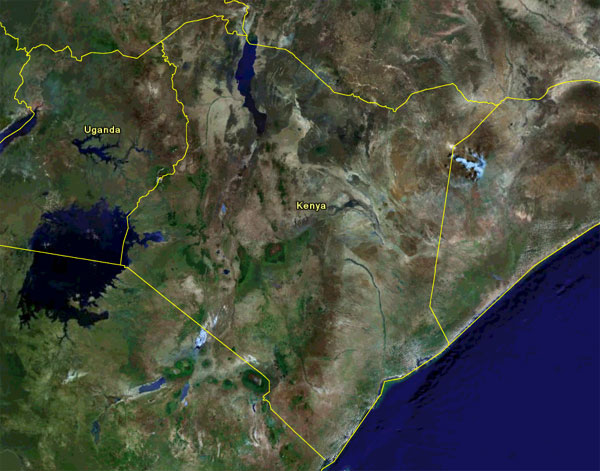

Image copyright Google Earth, MDA EarthSet, DigitalGlobe 2005

CIA-World Factbook Profile
FAO-Forestry Profile
World Resources Institute


Last updated: 4 Feb 2006


what's new | rainforests home | for kids | help | madagascar | search | about | languages | contact

Copyright Rhett Butler 1994-2009