TROPICAL RAINFORESTS
Mongabay.com is considered a leading source of information on tropical forests by some of the world's top ecologists and conservationists.

MALAYSIA

Malaysia Forest Figures

Forest Cover
Total forest area: 20,890,000 ha
% of land area: 63.6%

Primary forest cover: 3,820,000 ha
% of land area: 11.6%
% total forest area: 18.3%

Deforestation Rates, 2000-2005
Annual change in forest cover: -140,200 ha
Annual deforestation rate: -0.7%
Change in defor. rate since '90s: 85.1%
Total forest loss since 1990: -1,486,000 ha
Total forest loss since 1990:-6.6%

Primary or "Old-growth" forests
Annual loss of primary forests: n/a
Annual deforestation rate: n/a
Change in deforestation rate since '90s: n/a
Primary forest loss since 1990: n/a
Primary forest loss since 1990:0.0%

Forest Classification
Public: 93.4%
Private: 6.6%
Other: 0%
Use
Production: 56.6%
Protection: 18.2%
Conservation: 5.4%
Social services: n/a
Multiple purpose: 19.8%
None or unknown: n/a

Forest Area Breakdown
Total area: 20,890,000 ha
Primary: 3,820,000 ha
Modified natural: n/a
Semi-natural: 15,497,000 ha
Production plantation: 1,573,000 ha
Production plantation: n/a

Plantations
Plantations, 2005: 1,573,000 ha
% of total forest cover: 7.5%
Annual change rate (00-05): -17,200,000 ha

Carbon storage
Above-ground biomass: 5,661 M t
Below-ground biomass: 1,359 M t

Area annually affected by
Fire: 1,000 ha
Insects: n/a
Diseases: n/a

Number of tree species in IUCN red list
Number of native tree species: 2,650
Critically endangered: 50
Endangered: 99
Vulnerable: 403

Wood removal 2005
Industrial roundwood: 20,600,000 m3 o.b.
Wood fuel: 3,414,000 m3 o.b.

Value of forest products, 2005
Industrial roundwood: $2,081,000,000
Wood fuel: $69,000,000
Non-wood forest products (NWFPs): n/a
Total Value: $2,150,000,000


More forest statistics for Malaysia

Malaysia's deforestation rate is accelerating faster than that of any other tropical country in the world, according to data from the United Nations. Analysis of figures from the Food and Agriculture Organization of the United Nations (FAO) shows that Malaysia's annual deforestation rate jumped almost 86 percent between the 1990-2000 period and 2000-2005. In total, Malaysia lost an average of 140,200 hectares—0.65 percent of its forest area—per year since 2000. For comparison, the Southeast Asian country lost an average of 78,500 hectares, or 0.35 percent of its forests, annually during the 1990s.

The Malaysian government failed to provide FAO with figures showing the change in extent of primary forests during the period. Primary forests—forests with no visible signs of past or present human activities—are considered the most biologically diverse ecosystems on the planet.

Declining forest cover in Malaysia results primarily from urbanization, agricultural fires, and forest conversion for oil-palm plantations and other forms of agriculture. Logging, which is generally excluded in deforestation figures from FAO, is responsible for widespread forest degradation in the country, and green groups have blamed local timber companies for failing to practice sustainable forest management. In late 2005—despite photographic evidence suggesting otherwise—the Samling Group denied claims from NGOs accusing the timber giant of recklessly harvesting timber in one of its Sarawak concessions on the island of Borneo.

Forest cover has fallen dramatically in Malaysia since the 1970s. While FAO says that forests still cover more than 60 percent of the country, only 11.6 percent of these forests are considered pristine.

Logging

During the 1980s, rampant logging in the Bornean states of Sabah and Sarawak allowed Malaysia to temporarily outpace Indonesia and become the world's largest exporter of tropical wood.

On paper, Malaysia has probably one of the best rainforest protection policies in developing Asia, but in practice logging still carries on as it always has. The majority of Malaysia's remaining forests are managed for timber production, and each state is empowered to formulate forest policy independently. During the past two decades, sustainable forest management has been non-existent. While Malaysia has the policy framework for sustainable forest management in the form of the National Forestry Act of 1984, it has failed to enforce the legislation.

Peninsular Malaysia's primary forests are mostly gone, though some magnificent forest still exists in Taman Negara, a national park. Scientists believe that at 130 million years old, the rainforests of Taman Negara are the oldest in the world.

Most of Malaysia's remaining primary forest exists on the island of Borneo in the states of Sabah and Sarawak, but the majority of the forest area in Malaysian Borneo—especially the lowlands—has been selectively logged, resulting in reduced biodiversity. Loggers are now operating in more marginal areas on rugged mountain slopes, which increases the risk of soil erosion and mudslides. In Sabah (Northeastern Borneo), cutting has slowed over the years after a period of rapid deforestation. Timber production appears to have shifted to Sarawak (Northwestern Borneo), where about half the forest cover is slated for logging. About 8 percent of the land area in Sarawak is designated as reserves, but these protected areas are generally understaffed and threatened by illegal logging and encroachment by colonists who settle along logging roads.

In the 1980s, through roadblocks and sabotage of logging equipment, the indigenous Penan of Borneo attempted to stop logging in their traditional homeland. Their protests were ruthlessly and savagely put down by the Malaysian government, which blocked media access to the region until the unrest was settled and the forest dwellers cleared. The attacks on the Penan brought international attention to the logging of Borneo's forests but appear to have had relatively little long-term impact, since logging increased dramatically in the following years.

Mining

Decades of mining in peninsular Malaysia have left a heavy mark on the environment. Deforestation, pollution of rivers, and siltation have resulted in agricultural losses, and road projects have opened new areas to colonization.

Cronyism

Despite the government's pro-environment overtones, the heavy-handed Malaysian government tends to side with development more than conservation. As of 2004, no court had ever ruled favorably in a major case on behalf of the native forest peoples displaced by rainforest destruction. In the 1990s, the government overturned a High Court decision that would have prevented Bakun dam, a huge hydroelectric project that would flood 170,000 acres (69,000 hectares) of forest. The $2-billion-dollar project has since been plagued with cost overruns and delays. It now appears that the dam—scheduled for completion in 2003—will only be expected to begin generating electricity in late 2009. Further, the local Sarawak market has no need for the power, and undersea transmission lines that would have connected the dam to peninsular Malaysia will not even be laid. Some local commentators say the only purpose behind the project was to benefit Sarawak politicians and their cronies.

Cronyism extends into other industries as well, including palm oil. Malaysia is currently the world's largest producer of palm oil, and many of the largest producers have strong political ties. Promoted by incentives which give plantation owners a 100 percent tax exemption for 10 years, thousands of hectares of forest have been cleared for palm oil and other types of plantations. While plantations on cleared and degraded forest lands are ecologically and economically beneficial, clearing natural forest for plantations results in increased erosion and biodiversity loss.

Transmigration

Like Indonesia, the Malaysian government sponsored transmigration programs to open up rainforest for cash crop production. Between 1956 and the 1980s, Malaysia converted more than 15,000 square kilometers of forest for resettlement programs.

Fires

Periodic fires, usually coinciding with the el Niño events, burn thousands of hectares across Malaysia, especially on the island of Borneo. The haze from these fires and the fires in Kalimantan (Indonesia) cause serious pollution and health problems in Malaysia.

Back in the 1990s, the Malaysian government reacted to fires by ordering media blackouts to avoid spooking tourists and inciting panic over the health impact. Today this has changed as the government increasingly blames Indonesia for failing to control wildfires.

Biodiversity

Malaysia is home to some 15,500 species of higher plants, 746 birds, 300 mammals, 379 reptiles, 198 amphibians, and 368 species of fish.

On paper, more than 30% of Malaysia's land area is under some form of protection, although some "conservation" areas are specifically managed for logging.

Pictures from Malaysia

Recent articles | Malaysia news updates | XML

Sumatran rhino pregnant: conservationists hope third time's the charm
(02/07/2012) Ratu, a female Sumatra rhino (Dicerorhinus sumatrensis), is in the eleventh month of her third pregnancy raising hopes for a successful birth of one of the world's most imperiled big mammals. Ratu suffered two prior miscarriages, but researchers believe the current pregnancy—which still has four to five months to go (for a total term of around 15-16 months)—could produce what Indonesian officials have long hoped for: a bundle of joy at the Sumatran Rhino Sanctuary in Sumatra. With only around 200 Sumatran rhinos surviving today in Indonesia and Bornean Malaysia, many conservationists see such breeding efforts as the last and best chance to save the Critically Endangered species from extinction.


Photos of the day: satellite tagging a 12-foot saltwater crocodile
(02/06/2012) Researchers in the Malaysian state of Sabah on Borneo have successfully satellite-tagged a 3.6 meter (11.8 feet) saltwater crocodile (Crocodylus porosus) in an effort to study human-wildlife conflict with the world's largest reptile. As massive, powerful reptiles they are quite capable of injuring and killing adult humans.


Forgotten species: the wild jungle cattle called banteng
(01/31/2012) The word "cattle," for most of us, is the antithesis of exotic; it's familiar like a family member one's happy enough to ignore, but doesn't really mind having around. Think for a moment of the names: cattle, cow, bovine...likely they make many of us think more of the animals' byproducts than the creatures themselves—i.e. milk, butter, ice cream or steak—as if they were an automated food factory and not living beings. But if we expand our minds a bit further, "cattle" may bring up thoughts of cowboys, Texas, herds pounding the dust, or merely grazing dully in the pasture. But none of these titles, no matter how far we pursue them, conjure up images of steamy tropical rainforest or gravely imperiled species. A cow may be beautiful in its own domesticated sort-of-way, but there is nothing wild in it, nothing enchanting. However like most generalizations, this idea of cattle falls to pieces when one encounters, whether in literature or life, the banteng.


Palm oil does not meet U.S. renewable fuels standard, rules EPA
(01/27/2012) The U.S. Environmental Protection Agency (EPA) ruled on Friday that palm oil-based biofuels will not meet the renewable fuels standard due to carbon emissions associated with deforestation.


Logging of primary rainforests not ecologically sustainable, argue scientists
(01/25/2012) Tropical countries may face a risk of 'peak timber' as continued logging of rainforests exceeds the capacity of forests to regenerate timber stocks and substantially increases the risk of outright clearing for agricultural and industrial plantations, argues a trio of scientists writing in the journal Biological Conservation. The implications for climate, biodiversity, and local economies are substantial.


'Christmas miracle' for endangered rhinos
(12/24/2011) Conservationists and wildlife officials in the Malaysian state of Sabah airlifted a young female Sumatran Rhinoceros — one of the world's most endangered animals — to an area of forest where she would encounter a potential partner, reports the Sabah Wildlife Department and Borneo Rhino Alliance. Sumatran Rhinoceros populations are so low, some individuals live in areas where they have no hope of ever finding another rhino.


Top 10 Environmental Stories of 2011
(12/22/2011) Many of 2011's most dramatic stories on environmental issues came from people taking to the streets. With governments and corporations slow to tackle massive environmental problems, people have begun to assert themselves. Victories were seen on four continents: in Bolivia a draconian response to protestors embarrassed the government, causing them to drop plans to build a road through Tipnis, an indigenous Amazonian reserve; in Myanmar, a nation not known for bowing to public demands, large protests pushed the government to cancel a massive Chinese hydroelectric project; in Borneo a three-year struggle to stop the construction of a coal plant on the coast of the Coral Triangle ended in victory for activists; in Britain plans to privatize forests created such a public outcry that the government not only pulled back but also apologized; and in the U.S. civil disobedience and massive marches pressured the Obama Administration to delay a decision on the controversial Keystone XL pipeline, which would bring tar sands from Canada to a global market.


The other side of the Penan story: threatened tribe embraces tourism, reforestation
(12/19/2011) News about the Penan people is usually bleak. Once nomadic hunter-gatherers of the Malaysian state of Sarawak on Borneo, the indigenous Penan have suffered decades of widespread destruction of their forests and an erosion of their traditional culture. Logging companies, plantation developments, massive dams, and an ambivalent government have all played a role in decimating the Penan, who have from time-to-time stood up to loggers through blockades, but have not been successful in securing recognition of legal rights to their traditional lands. Yet even as the Penan people struggle against the destruction of their homelands, they are not standing still. Several Penan villages have recently begun a large-scale reforestation program, a community tourism venture, and proclaimed their a portion of their lands a "Peace Park."


Environmental groups to Japan: stop importing illegally logged timber
(12/16/2011) A coalition of environmental NGOs have called upon Japan to adopt stronger measures to block illicit timber imports, alleging that Japanese companies are buying illegally logged wood from Samling Global, a Malaysian logging company.


NGOs call for arrest of Malaysian leader for corruption, money laundering
(12/12/2011) A coalition of Malaysian and international NGOs are calling for the arrest of Sarawak chief minister Abdul Taib Mahmud and 14 family members for alleged abused of power, corruption, and money laundering, reports the Bruno Manser Fund, a group that has signed the letter urging action.


Wildlife official: palm oil plantations behind decline in proboscis monkeys
(12/05/2011) The practice of palm oil plantations planting along rivers is leading to a decline in proboscis monkeys (Nasalis larvatus) in the Malaysian state of Sabah on Borneo, says the director of the Sabah Wildlife Department, Laurentius Ambu. Proboscis monkeys, known for their bulbous noses and remarkable agility, depend on riverine forests and mangroves for survival, but habitat destruction has pushed the species to be classified as Endangered by the IUCN Red List.


Sarawak ruler has acquired billions in 'illicit' assets, alleges investigation
(12/04/2011) The leader of the Malaysian state of Sarawak has acquired billions of dollars' worth of "illicit" assets, alleges a new investigation by the Bruno Manser Fund, which reveals holdings in over 400 companies across two dozen countries.


Royal Society offers free special issue on rainforest conservation
(12/01/2011) For one month the Royal Society is offering a special theme issue of its Philosophical Transaction B journal on rainforest conservation for free. Entitled 'The future of Southeast Asian rainforests in a changing landscape and climate', the issue looks largely at studies conducted in Malaysian Borneo's Danum Valley. The issue includes a wide-range of studies, including comparing biodiversity in protected forests versus palm oil plantations, seed dispersal in fragmented forests, and in-depth looks at the chemistry of rainforests.


Cargill should do more to end use of problematic palm oil, says RAN
(11/24/2011) As part of our coverage of the 9th Annual Roundtable Meeting on Sustainable Palm Oil currently underway in Kota Kinabalu in Sabah, Malaysia, mongabay.com is interviewing participants and attendees. In the following interview, mongabay.com speaks with the delegation from the Rainforest Action Network (RAN), an advocacy group which has been critical of some Roundtable on Sustainable Palm Oil (RSPO) members for what is sees as ongoing social and environmental problems.


Animal picture of the day: tracking the world's smallest elephant
(11/15/2011) Researchers have fitted three Bornean elephants with satellite collars to track them across the Lower Kinabatangan Wildlife Sanctuary, in the Malaysian state of Sabah, Borneo. The effort means currently five elephants are being tracked. The tracking is a part of a collaborative effort by the Sabah Wildlife Department (SWD), the NGO HUTAN, and the Danau Girang Field Centre (DGFC).


Malaysia to spend $7.7M to defend palm oil from criticism
(11/09/2011) The Malaysian government will spend 24 million ringgit ($7.7 million) in 2011 and 2012 to counter criticism over the social and environmental impact of palm oil, reports ANTARA.


Malaysia must take action to avoid extinction of its last rhinos
(11/05/2011) Malaysia must take immediate action to prevent the extinction of the handful of rhinos that survive on the island of Borneo, says a coalition of environmental groups.


Malaysian sustainable timber certification fails Dutch standards
(10/23/2011) An independent panel in the Netherlands has found that the Malaysian Timber Certification Scheme (MTCS) falls short of Dutch standards for sustainable forestry. The final decision comes after a series of judgements and appeals with the latest panel concluding that MTCS still allows natural forest to be destroyed for monoculture plantation and that the scheme ignores the rights of indigenous people.


After protracted campaign, Girl Scouts pledges to cut out some palm oil
(10/02/2011) Girl Scouts USA has announced that it will lessen palm oil in its ubiquitous cookies by using alternatives when possible and cutting overall usage. The organization also committed to purchasing GreenPalm certificates for all of its palm oil in order to financially support more environmentally sustainable palm oil, even if the palm oil in the cookies is not.


Animal picture of the day: world's tiniest rhino for World Rhino Day
(09/22/2011) The Sumatran rhino is the world's smallest species of rhino, but the Bornean rhino—a subspecies of the Sumatra—is even tinier.


Logged rainforests are a cheap conservation option
(09/14/2011) With old-growth forests fast diminishing and land prices surging across Southeast Asia due to rising returns from timber and agricultural commodities, opportunities to save some of the region's rarest species seem to be dwindling. But a new paper, published in the journal Conservation Letters, highlights an often overlooked opportunity for conservation: selectively logged forests.


Deutsche Bank faces money-laundering investigation over dealings with Malaysian chief minister
(09/12/2011) Banking giant Deutsche Bank is under investigation by the German Federal Financial Supervisory Authority (BaFin) for its dealings with the family of Abdul Taib Mahmud, the chief minister of the Malaysian state of Sarawak, reports the Bruno Manser Fund, a group that campaigns on behalf of forest people in Borneo.


Malaysian court blocks rainforest tribes' fight against mega-dam in Borneo
(09/09/2011) Indigenous tribes in Borneo suffered a stinging defeat Thursday after Sarawak's highest court ruled against them in 12-year-long legal battle. Tribal groups had challenged the Malaysian state government for seizing indigenous lands in order to build a massive hydroelectric power plant, dubbed the Bakun dam, but the three-person top court found unanimously against the tribes.


Another major elephant ivory bust in Malaysia
(09/09/2011) Customs authorities in Malaysia seized two containers full of 695 elephant tusks in the country’s largest port, reports TRAFFIC, the wildlife trade monitoring network.


Busted: 1,835 elephant tusks confiscated in two seizures connected by Malaysia
(08/31/2011) Two massive seizures in the last week—one in Zanzibar and the other in Hong Kong—have confiscated nearly two thousand ivory tusks as elephant poaching continues to rise. Both seizures have connections to Malaysia, highlighting the growing role of a new intermediate player in the illegal ivory trade.


Suggested reading - Books


Unless otherwise specified, this article was written by Rhett A. Butler [Bibliographic citation for this page]

Other resources

Contact me if you have suggestions on other rainforest-related environmental sites and resources for this country.
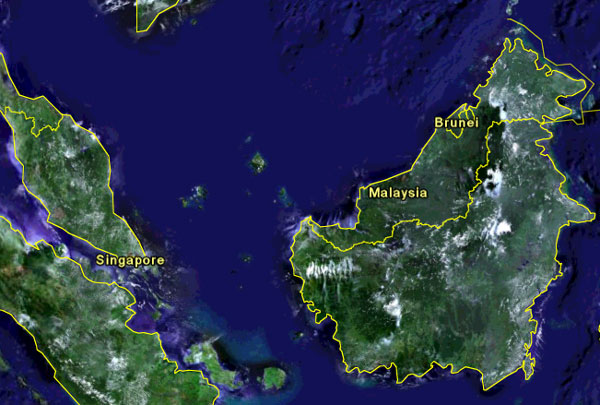

Image copyright Google Earth, MDA EarthSet, DigitalGlobe 2005

CIA-World Factbook Profile
FAO-Forestry Profile World Resources Institute
Last updated: 4 Feb 2006


For kids

Tour: the Amazon

Rainforest news

Tour: Indonesia's rainforests

 Home
 What's New
 About
 Rainforests
   Mission
   Introduction
   Characteristics
   Biodiversity
   The Canopy
   Forest Floor
   Forest Waters
   Indigenous People
   Deforestation
   Consequences
   Saving Rainforests
   Amazon
   Borneo
   Congo
   New Guinea
   Sulawesi
   REDD
   Country Profiles
   Statistics
   Works Cited
   For Kids
   For Teachers
   Photos/Images
   Expert Interviews
   Rainforest News
  Forest data
   Global deforestation
   Tropical deforestation
   By country
   Deforestation charts
   Regional forest data
   Deforestation drivers
 XML Feeds
 Pictures
 Books
 Education
 Newsletter
 Contact


 CONTENTS
Rainforests
Tropical Fish
News
Madagascar
Pictures
Kids' Site
Languages
TCS Journal
About
Archives
Topics | RSS
Newsletter


 Other languages
Arabic
Bengali
Chinese (CN) (expanded)
Chinese (TW)
Croatian
Danish
Dutch
Farsi
French (expanded)
German (expanded)
Greek
Hindi
Hungarian
Indonesian
Italian
Japanese (expanded)
Javanese
Korean
Malagasy
Malay
Marathi
Norwegian
Polish
Portuguese (expanded)
Russian
Slovak
Spanish (expanded)
Swahili
Swedish
Ukrainian


 WEEKLY NEWSLETTER
 Email:


 INTERACT
Facebook
Twitter
Contact
Help
Photo store
Mongabay gear


what's new | rainforests home | for kids | help | madagascar | search | about | languages | contact


Copyright Rhett Butler 1994-2011

"Rainforest" is used interchangeably with "rain forest" on this site. "Jungle" is generally not used.