TROPICAL RAINFORESTS
Mongabay.com is considered a leading source of information on tropical forests by some of the world's top ecologists and conservationists.

MYANMAR (BURMA)

Myanmar Forest Figures

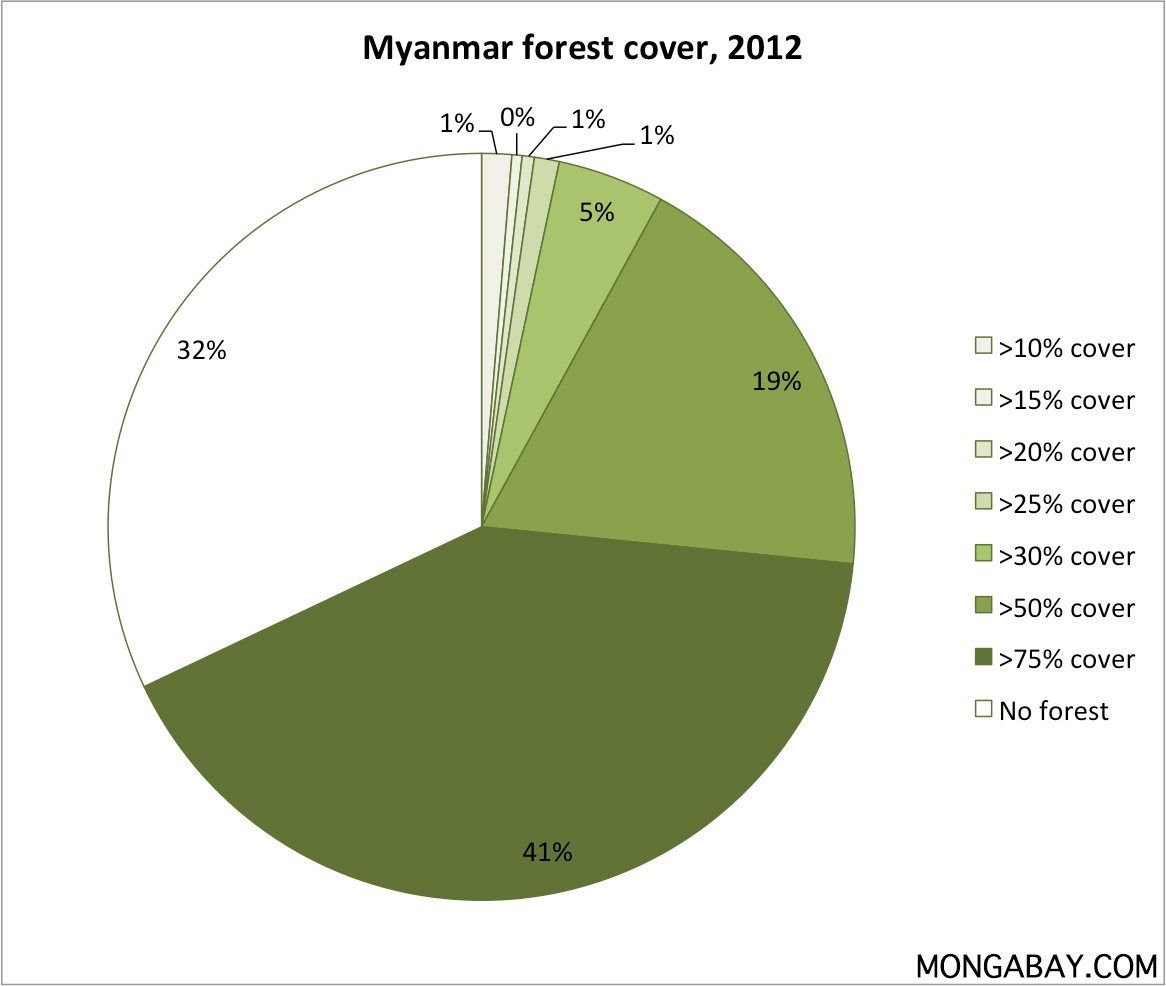
Forest Cover
Total forest area: 32,222,000 ha
% of land area: 49%

Primary forest cover: n/a
% of land area: 0.0%
% total forest area: n/a

Deforestation Rates, 2000-2005
Annual change in forest cover: -466,400 ha
Annual deforestation rate: -1.4%
Change in defor. rate since '90s: 13.5%
Total forest loss since 1990: -6,997,000 ha
Total forest loss since 1990:-17.8%

Primary or "Old-growth" forests
Annual loss of primary forests: n/a
Annual deforestation rate: n/a
Change in deforestation rate since '90s: n/a
Primary forest loss since 1990: n/a
Primary forest loss since 1990:n/a

Forest Classification
Public: 100%
Private: 0%
Other: 0%
Use
Production: 77%
Protection: 4.7%
Conservation: 15.2%
Social services: n/a
Multiple purpose: 3.2%
None or unknown: n/a

Forest Area Breakdown
Total area: 32,222,000 ha
Primary: n/a
Modified natural: 31,373,000 ha
Semi-natural: n/a
Production plantation: 696,000 ha
Production plantation: 153,000 ha

Plantations
Plantations, 2005: 849,000 ha
% of total forest cover: 2.6%
Annual change rate (00-05): 30,600,000 ha

Carbon storage
Above-ground biomass: 5,109 M t
Below-ground biomass: 1,226 M t

Area annually affected by
Fire: 6,500,000 ha
Insects: n/a
Diseases: n/a

Number of tree species in IUCN red list
Number of native tree species: 2,000
Critically endangered: 13
Endangered: 12
Vulnerable: 12

Wood removal 2005
Industrial roundwood: 3,880,000 m3 o.b.
Wood fuel: 39,180,000 m3 o.b.

Value of forest products, 2005
Industrial roundwood: $838,479,000
Wood fuel: $51,415,000
Non-wood forest products (NWFPs): $11,761,000
Total Value: $901,655,000


More forest statistics for Myanmar

Myanmar, the country formerly called Burma, has come under fire in recent years for alleged severe human rights abuses by the military-run government, known by the misleading name of the State Peace and Development Council. This government installed itself in a military coup in 1988 and promised democratic elections the next year. The opposition party, the National League for Democracy, won resounding victory (80% of parliamentary seats) at the polls, but the military prevented them from assuming their seats and arrested many, including party leader Aung San Suu Kyi who has been periodically imprisoned or under house arrest since then.

The Burmese goverment is believed to get significant amounts of revenue from drug trafficking. Heroin, amphetamines, and other narcotics form the basis of the economy for this increadingly erratic and isolated pariah state. Relocation, imprisonment, and intimidation are commonly employed to quiet dissent within the country and the used of forced labor—or virtual slavery—is widespread according to human rights' groups and Burmese refugees living in border camps in Thailand.

Until the late 1990s, large parts of southern and eastern Burma had remained free from military rule due to the resistance of indigenous groups. However the inflow of foreign capital, mainly through offshore natural gas concessions to foregin firms, has given the military the means to assert control over these regions and increasingly exploit teak and other forest resources, in addition to local populations.

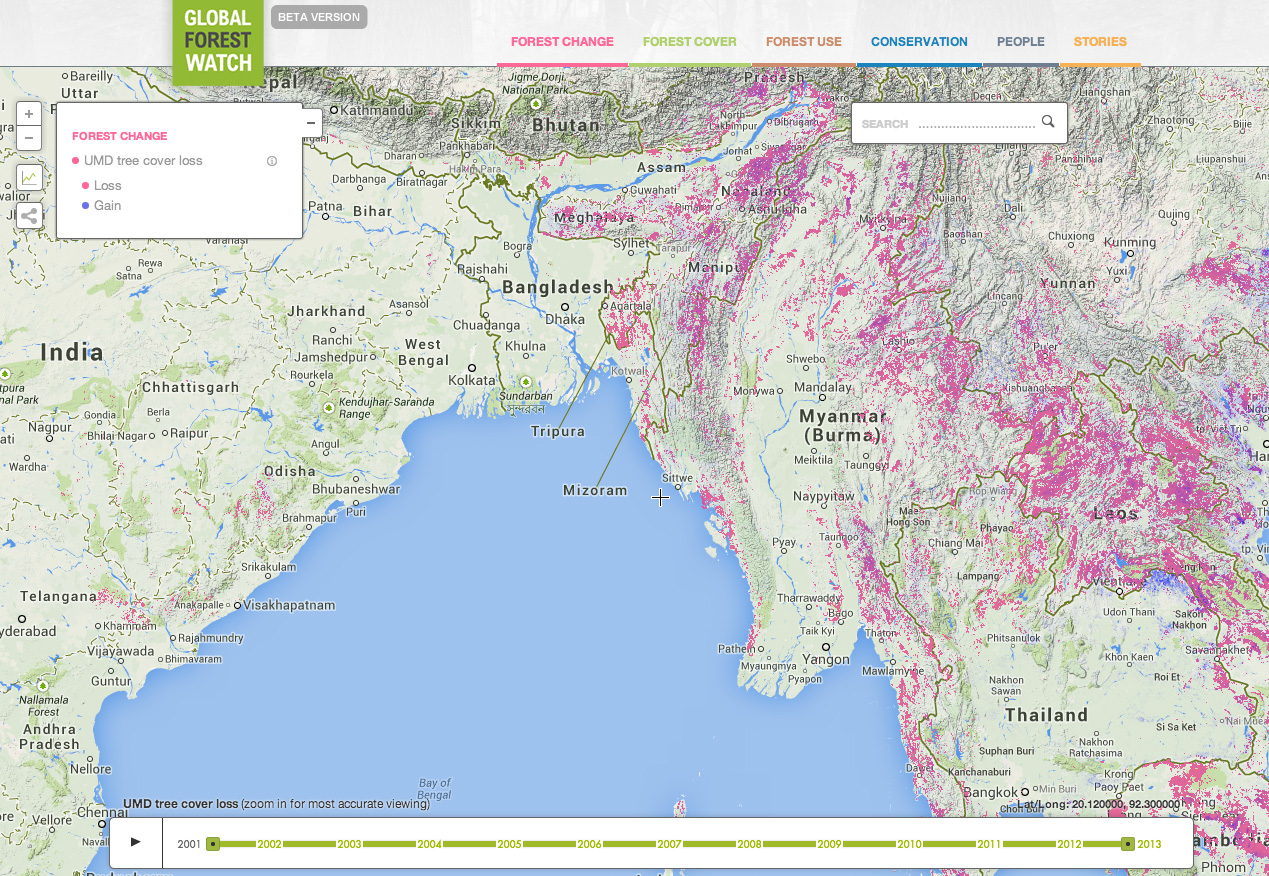
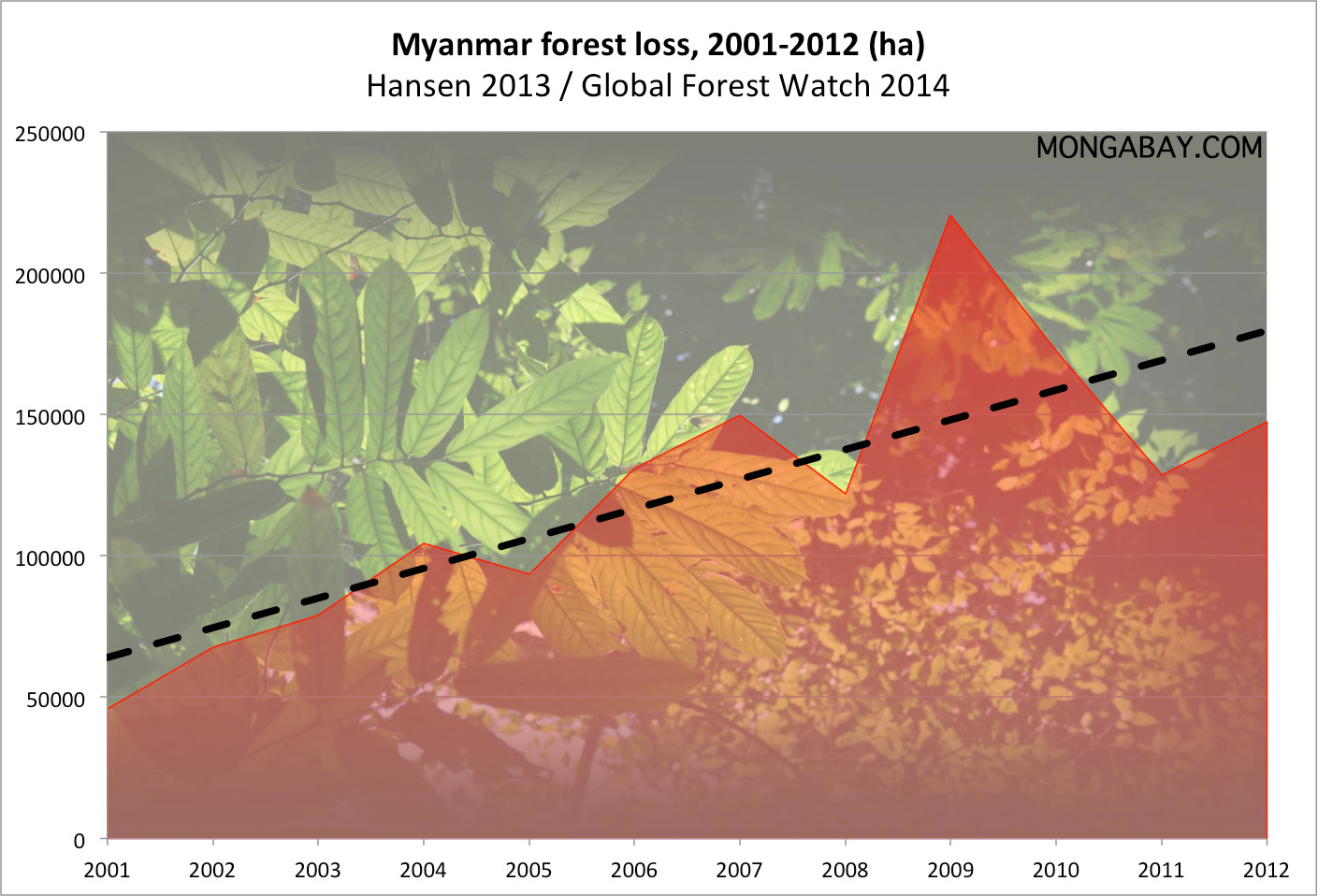
What this all means is that today Burma has one of the highest rates of forest loss on Earth. Between 1990 and 2005, Burma lost an average of 466,000 hectares of forest per year—or 18 percent of its total forest cover during that period. The deforestation rate has increased by 13.5 percent since the close of the 1990s.

Deforestation and forest degradation in Burma largely results from agriculture, logging, fuel wood collection, and, to a lesser extent, development for energy infrastructure. Logging in Burma is predominantly for teak, although the government is trying to promote the country's lesser known timber species to the international market. While there has been an official ban on raw log exports since 1993, evidence collected by several groups, including Global Witness, suggests that illegal logging is ride in Burma.

Global Witness reports that in 2004, more than 1 million cubic meters of timber—about 95% of Burma's total timber exports to China—were illegally exported from northern Burma to Yunnan Province. The trade is worth an estimated $250 million.

Burma's forest loss, and lack of forest protection (less than 1 percent of the country is protected) puts its biological diversity at risk. Burma has some 1709 known species of amphibians, birds, mammals and reptiles according to figures from the World Conservation Monitoring Centre. Of these, 4.7% are endemic and 5.9% are threatened. Burma is home to at least 7000 species of vascular plants, of which 15.3% are endemic.

Recent articles | Burma news updates | XML

Mekong region has lost a third of its forests in 30 years, may lose another third by 2030
(05/03/2013) The Greater Mekong region of Cambodia, Laos, Myanmar (Burma), Thailand and Vietnam will lose a third of its remaining forest cover by 2030 unless regional governments improve management of natural resources and transition toward a greener growth model, warns a new report issued by WWF.


The river of plenty: uncovering the secrets of the amazing Mekong
(04/23/2013) Home to giant catfish and stingrays, feeding over 60 million people, and with the largest abundance of freshwater fish in the world, the Mekong River, and its numerous tributaries, brings food, culture, and life to much of Southeast Asia. Despite this, little is known about the biodiversity and ecosystems of the Mekong, which is second only to the Amazon in terms of freshwater biodiversity. Meanwhile, the river is facing an existential crisis in the form of 77 proposed dams, while population growth, pollution, and development further imperil this understudied, but vast, ecosystem.


'Exporting deforestation': China is the kingpin of illegal logging
(11/29/2012) Runaway economic growth comes with costs: in the case of China's economic engine, one of them has been the world's forests. According to a new report by the Environmental Investigation Agency (EIA), China has become the number one importer of illegal wood products from around the world. Illegal logging—which threatens biodiversity, emits carbon, impoverishes local communities, and is often coupled with other crimes—has come under heavy pressure in recent years from the U.S., the EU, and Australia. Each of these has implemented, or will soon implement, new laws that make importing and selling illegal wood products domestic crimes. However, China's unwillingness to tackle its vast appetite for illegal timber means the trade continues to decimate forests worldwide.


Burma warns of deforestation crisis
(08/23/2012) An official warned that Myanmar is facing a deforestation crisis due to poor forest management, illegal logging, and fuelwood collection, reports Chinese state media.


Burma: slowly opening its doors
(08/21/2012) As a 'road junky', I know what you're thinking: 'Burma is reforming so quickly, let's rush off to Burma before tourists snatch up all its unspoiled beauty!' I had the same idea, and after an incredible trip to Burma, I have to say that I was right. However, I must tell you that traveling in Burma is both rewarding and challenging. In Burma, I found myself spending a day in Bagan being driven from majestic temple to majestic temple by a betel-chewing, elementary-school-aged, driver who took the horse cart right through a plowed and planted field on the way to Sule Pagoda where I watched the sunset of a lifetime. I found myself in awe of the red-brick stupas, colorful frescoes, pastoral simplicity, and peace found in off-season induced solitude amongst some of the ruins. Still, in spite of these wonderful experiences, I also found that my optimism over the country's recent transformation was sometimes tempered by evidence of its tumultuous past.


First pictures of newly discovered monkey in China published
(07/27/2012) Researchers have published the first evidence that a recently discovered monkey ranges into China, releasing pictures of the Rhinopithecus strykeri snub-nosed monkey in its natural habitat in Yunnan province. The photos are published in the current issue of the American Journal of Primatology.


Blue tarantula, walking cactus, and a worm from Hell: the top 10 new species of 2011
(05/23/2012) A sneezing monkey, a blue tarantula, and an extinct walking cactus are just three of the remarkable new species listed in the annual Top Ten New Species put together by the International Institute for Species Exploration at Arizona State University. This year's list includes a wide-variety of life forms from fungi to flower and invertebrate to primate.


New 'bony-tongue' fish discovered in Myanmar
(05/18/2012) A new species of arowana, a highly valued aquarium fish, has been described from southern Myanmar (Burma). The description is published in last month's issue of the journal Aqua.


New population of Myanmar snub-nosed monkey discovered in China
(05/16/2012) Scientists in China have located a second population of the Myanmar snub-nosed monkey (Rhinopithecus strykeri), a primate that was only first discovered two years ago in Myanmar, also known as Burma. Long Yongcheng, scientist with the Nature Conservancy in China, told the China Daily that his team have discovered 50-100 Myanmar snub-nosed monkeys in the Gaoligong Mountain Natural Reserve near the border with Myanmar in Yunnan Province.


NGO: lifting sanctions on Myanmar must lead to forestry reform
(04/26/2012) Following historic elections, many foreign powers have relaxed or lifted sanctions against Myanmar, also known as Burma. But the Environmental Investigation Agency (EIA) warns that the end of sanctions presents Myanmar and the world with a choice: further plundering of the country's forests for outside markets or large-scale forestry reform.


Hail Mary effort aims to save the world's most endangered turtles
(04/17/2012) The Wildlife Conservation Society (WCS) has pledged to work with all of its institutions to save at least half of the world's most 25 endangered turtles as listed in a report by WCS and the Turtle Conservation Coalition last year. The program will include both conservation work in the field as well as participation from WCS's zoological institutions for captive breeding and future reintroductions. Even with WCS's ambitious program, however, it is likely this century will see a number of turtle extinctions.


UN: wild teak forests declining
(03/28/2012) Wild teak forests continue to decline, threatening genetic diversity, while commercial planted teak forests are on the rise, according to a new assessment by the Food and Agriculture Organization (FAO). Overall, teak forests have declined by 1.3 percent, or 385,000 hectares, worldwide from 1992 to 2010. Teak (Tectona grandis) is used for a variety of commercial purposes, including outdoor furniture and flooring.


Forgotten species: the wild jungle cattle called banteng
(01/31/2012) The word "cattle," for most of us, is the antithesis of exotic; it's familiar like a family member one's happy enough to ignore, but doesn't really mind having around. Think for a moment of the names: cattle, cow, bovine...likely they make many of us think more of the animals' byproducts than the creatures themselves—i.e. milk, butter, ice cream or steak—as if they were an automated food factory and not living beings. But if we expand our minds a bit further, "cattle" may bring up thoughts of cowboys, Texas, herds pounding the dust, or merely grazing dully in the pasture. But none of these titles, no matter how far we pursue them, conjure up images of steamy tropical rainforest or gravely imperiled species. A cow may be beautiful in its own domesticated sort-of-way, but there is nothing wild in it, nothing enchanting. However like most generalizations, this idea of cattle falls to pieces when one encounters, whether in literature or life, the banteng.


Camera traps snap first ever photo of Myanmar snub-nosed monkey
(01/10/2012) In 2010 researchers described a new species of primate that reportedly sneezes when it rains. Unfortunately, the new species was only known from a carcass killed by a local hunter. Now, however, remote camera traps have taken the first ever photo of the elusive, and likely very rare, Myanmar snub-nosed monkey (Rhinopithecus strykeri), known to locals as mey nwoah, or 'monkey with an upturned face'. Locals say the monkeys are easy to locate when it rains, because the rain catches on their upturned noses causing them to sneeze.


Top 10 Environmental Stories of 2011
(12/22/2011) Many of 2011's most dramatic stories on environmental issues came from people taking to the streets. With governments and corporations slow to tackle massive environmental problems, people have begun to assert themselves. Victories were seen on four continents: in Bolivia a draconian response to protestors embarrassed the government, causing them to drop plans to build a road through Tipnis, an indigenous Amazonian reserve; in Myanmar, a nation not known for bowing to public demands, large protests pushed the government to cancel a massive Chinese hydroelectric project; in Borneo a three-year struggle to stop the construction of a coal plant on the coast of the Coral Triangle ended in victory for activists; in Britain plans to privatize forests created such a public outcry that the government not only pulled back but also apologized; and in the U.S. civil disobedience and massive marches pressured the Obama Administration to delay a decision on the controversial Keystone XL pipeline, which would bring tar sands from Canada to a global market.


Photos: 208 species discovered in endangered Mekong region in 2010
(12/14/2011) Last year researchers scoured forests, rivers, wetlands, and islands in the vanishing ecosystems of the Mekong Delta to uncover an astounding 208 new species over a twelve month period. A new report by the World Wide Fund for Nature (WWF) highlights a number of the new species—from a new snub-nosed monkey to five new meat-eating pitcher plants to a an all-female, cloning lizard—while warning that many of them may soon be gone as the Mekong Delta suffers widespread deforestation, over-hunting and poaching, massive development projects, the destruction of mangroves, pollution, climate change, and a growing population.


The dam-maker: China involved in 289 dam projects worldwide
(11/06/2011) China is currently involved in 289 hydroelectric projects worldwide, as reported by International Rivers. Most of the dams are built for hydropower, and over half are considered 'large' projects. The list includes completed dams, one currently under construction, and ones in initial planning stages.


Public opposition pushes Myanmar to suspend giant Chinese dam
(10/04/2011) Large-scale opposition has pushed the Myanmar government to suspend construction of a massive Chinese dam. Being built on the confluence of the Mayhka amd Malihka rivers at the head of Irrawaddy River, the Myitsone Dam would have created a reservoir the size of Singapore and has already pushed 12,000 people off their land. China Power Investment Corporation, which is building the dam, has fired back at the Myanmar government saying their decision will lead to 'a series of legal issue'.


Cute animal picture of the day: tufted deer fawn
(08/07/2011) Native to China and, perhaps, Myanmar (Burma), the tufted deer lives in mountainous damp forests.


Bear bile trade, both legal and illegal, ubiquitous in Asia
(05/16/2011) Surveying 13 nations and territories in Asia, the wildlife trade organization TRAFFIC found that the bear bile trade remains practically ubiquitous in the region. In many cases the trade, which extracts bile from captive bears' gall bladders for sale as a pharmaceutical, flouts both local and international law, including Appendix I of Convention on International Trade in Endangered Species of Wild Fauna and Flora (CITES ).


From Cambodia to California: the world's top 10 most threatened forests
(02/02/2011) Growing populations, expanding agriculture, commodities such as palm oil and paper, logging, urban sprawl, mining, and other human impacts have pushed many of the world's great forests to the brink. Yet scientists, environmentalists, and even some policymakers increasingly warn that forests are worth more standing than felled. They argue that by safeguarding vulnerable biodiversity, sequestering carbon, controlling erosion, and providing fresh water, forests provide services to humanity, not to mention the unquantifiable importance of having wild places in an increasingly human-modified world. Still, the decline of the world's forests continues: the FAO estimating that around 10 million hectares of tropical forest are lost every year. Of course, some of these forests are more imperiled than others, and a new analysis by Conservation International (CI) has catalogued the world's 10 most threatened forests.


Record number of nations hit all time temperature highs
(11/23/2010) To date, nineteen nations have hit or matched record high temperatures this year, according to Jeff Master's Wunder Blog, making 2010 the only year to have so many national records. In contrast, no nation this year has hit a record cold temperature.


Picture: new monkey discovered in Myanmar
(10/26/2010) Hunters' reports have led scientists to discover a new species of monkey in the northern forests of Myanmar. Discovered by biologists from the Myanmar Biodiversity and Nature Conservation Association with support from primatologists with Fauna & Flora International (FFI) and the People Resources and Biodiversity Foundation, the strange looking primate is a member of the snub-nosed monkey family, adding a fifth member to this unmistakably odd-looking group of Asian primates. However, the species survives in only a small single population, threatened by Chinese logging and hunting.


Nation's wealth does not guarantee green practices
(08/11/2010) Developing countries are not the only ones that could benefit from a little environmental support. Wealthier countries may need to 'know themselves' and address these issues at home too. According to a recent study in the open access journal PLoS ONE, wealth may be the most important factor determining a country’s environmental impact. The team had originally planned to study "country-level environmental performance and human health issues," lead author Corey Bradshaw, Director of Ecological Modeling and professor at the University of Adelaide, told mongabay.com. Once they began looking at the available indexes, however, they saw the need for a purely environmental analysis.


Summer from hell: seventeen nations hit all-time heat records
(08/09/2010) The summer isn't over yet, but already seventeen nations have matched or beaten their all-time heat records. According to Jeff Masters' WunderBlog, Belarus, the Ukraine, Cyprus, Russia, Finland, Qatar, the Sudan, Saudi Arabia, Niger, Chad, Kuwait, Iraq, Pakistan, Colombia, Myanmar, Ascension Island, and the Solomon Islands have all equaled or broken their top temperature records this year. In addition, the hottest temperature ever recorded in Asia was taken in Pakistan at 128 degrees Fahrenheit (53 degrees Celsius); this incredible temperature still has to be reviewed by the World Meteorological Organization (WMO).


Suggested reading - Books


Unless otherwise specified, this article was written by Rhett A. Butler [Bibliographic citation for this page]

Other resources

Contact me if you have suggestions on other rainforest-related environmental sites and resources for this country.


Image from the CIA World Factbook

CIA-World Factbook Profile
FAO-Forestry Profile
World Resources Institute


Last updated: 4 Feb 2006


For kids

Tour: the Amazon

Rainforest news

Tour: Indonesia's rainforests

 Home
 What's New
 About
 Rainforests
   Mission
   Introduction
   Characteristics
   Biodiversity
   The Canopy
   Forest Floor
   Forest Waters
   Indigenous People
   Deforestation
   Consequences
   Saving Rainforests
   Amazon
   Borneo
   Congo
   New Guinea
   Sulawesi
   REDD
   Country Profiles
   Statistics
   Works Cited
   For Kids
   For Teachers
   Photos/Images
   Expert Interviews
   Rainforest News
  Forest data
   Global deforestation
   Tropical deforestation
   By country
   Deforestation charts
   Regional forest data
   Deforestation drivers
 XML Feeds
 Pictures
 Books
 Education
 Newsletter
 Contact


 CONTENTS
Rainforests
Tropical Fish
News
Madagascar
Pictures
Kids' Site
Languages
TCS Journal
About
Archives
Topics | RSS
Newsletter


 Other languages
Arabic
Bengali
Chinese (CN) (expanded)
Chinese (TW)
Croatian
Danish
Dutch
Farsi
French (expanded)
German (expanded)
Greek
Hindi
Hungarian
Indonesian
Italian
Japanese (expanded)
Javanese
Korean
Malagasy
Malay
Marathi
Norwegian
Polish
Portuguese (expanded)
Russian
Slovak
Spanish (expanded)
Swahili
Swedish
Ukrainian


 WEEKLY NEWSLETTER
 Email:


 INTERACT
Facebook
Twitter
Contact
Help
Photo store
Mongabay gear


what's new | rainforests home | for kids | help | madagascar | search | about | languages | contact

Copyright Rhett Butler 1994-2011

"Rainforest" is used interchangeably with "rain forest" on this site. "Jungle" is generally not used.