TROPICAL RAINFORESTS
 Home
 What's New
 About
 Submissions
 Rainforests
   Mission
   Introduction
   Characteristics
   Biodiversity
   The Canopy
   Forest Floor
   Forest Waters
   Indigenous People
   Deforestation
   Consequences
   Saving Rainforests
   Amazon rainforest
   Borneo rainforest
   Congo rainforest
   Country Profiles
   Statistics
   Works Cited
   For Kids
   For Teachers
   Photos/Images
   Expert Interviews
   Rainforest News
  Forest data
   Global deforestation
   Tropical deforestation
   By country
   Deforestation charts
   Regional forest data
 XML Feeds
 Other Languages
   Chinese
   French
   German
   Japanese
   Portuguese
   Spanish
 Pictures
 Books
 Links
 Newsletter
 Education
 Mongabay Sites
   Kids' site
   Travel Tips
   Tropical Fish
   Madagascar
 Contact


About this site
Providing tropical forest news, statistics, photos, and information, rainforests.mongabay.com is the world's most popular rainforest site. [more]


Weekly Newsletter
Enter your email:
Mongabay will never distribute your email address or send spam.


Share


Niger

Niger Forest Figures

Forest Cover
Total forest area: 1,266,000 ha
% of land area: 1%

Primary forest cover: 220,000 ha
% of land area: 0.2%
% total forest area: 17.4%

Deforestation Rates, 2000-2005
Annual change in forest cover: -12,400 ha
Annual deforestation rate: -1.0%
Change in defor. rate since '90s: -70.6%
Total forest loss since 1990: -679,000 ha
Total forest loss since 1990:-34.9%

Primary or "Old-growth" forests
Annual loss of primary forests: n/a
Annual deforestation rate: n/a
Change in deforestation rate since '90s: n/a
Primary forest loss since 1990: n/a
Primary forest loss since 1990:0.0%

Forest Classification
Public: 100%
Private: 0%
Other: 0%
Use
Production: n/a
Protection: 0.2%
Conservation: 17.4%
Social services: n/a
Multiple purpose: 82.4%
None or unknown: n/a

Forest Area Breakdown
Total area: 1,266,000 ha
Primary: 220,000 ha
Modified natural: 936,000 ha
Semi-natural: n/a
Production plantation: n/a
Production plantation: 110,000 ha

Plantations
Plantations, 2005: 110,000 ha
% of total forest cover: 8.7%
Annual change rate (00-05): 7,500,000 ha

Carbon storage
Above-ground biomass: 20 M t
Below-ground biomass: 5 M t

Area annually affected by
Fire: n/a
Insects: n/a
Diseases: n/a

Number of tree species in IUCN red list
Number of native tree species: 227
Critically endangered: 0
Endangered: 0
Vulnerable: 2

Wood removal 2005
Industrial roundwood: 594,000 m3 o.b.
Wood fuel: 11,879,000 m3 o.b.

Value of forest products, 2005
Industrial roundwood: n/a
Wood fuel: $92,334,000
Non-wood forest products (NWFPs): $5,295,000
Total Value: $97,629,000


More forest statistics for Niger

Niger, one of the world's poorest countries, has been especially hard hit by the collapse of the uranium market and is dependent on subsistence farming as the backbone of its economy. A high population growth rate puts pressure of the few remaining forest lands. Consequently, between 1990 and 2005, the country lost 679,000 hectares or 34.9 percent of its forest cover.

In Niger, formerly forested lands are plagued with soil loss and desertification. The Sahara desert, which already covers two-thirds of the country, is expanding at a rate of 200,000 hectares annually. In an effort to slow the Saraha's progress, the government planted more than 60 million trees between 1985 and 1997.

As of 2003, about 8 percent of Niger's land area was protected, but poaching and habitat loss are taking a heavy toll on the country's wildlife.

From a biodiversity standpoint, Niger has some 1,460 species of plants, 131 mammals, 493 birds, and 58 reptiles.

Indigenous people, forest communities in Africa control less than 2% of forest land
(05/28/2009) Less than 2 percent of Africa’s tropical forests are under community control, hindering efforts to slow deforestation and alleviate rural poverty, reports a new assessment from the International Tropical Timber Organization (ITTO) and the Rights and Resources Initiative (RRI), a global coalition of non-governmental and community organizations.


All about giraffes: an interview with a giraffe expert
(03/09/2009) Dr. Julian Fennessy probably knows the giraffe better than anyone. Trekking across savannah, forest, and the deserts of Africa, Fennessy is collecting genetic samples of distinct giraffe populations and overturning common wisdom regarding their taxonomies. It had long been accepted knowledge that the giraffe was made up of one species and several subspecies, however with Fennessy's work it now appears that several of the subspecies may in fact be distinct species. Such discoveries could have large conservation impacts, since conservation funds and efforts are largely devoted to species. The giraffe has suffered significant declines in the past decade with the total population dropping some 30 percent across Africa.


Photos: Rarest cheetah photographed for the first time
(02/23/2009) With only 250 individuals left the Saharan Cheetah is on the brink of extinction. Little-studied, this imperiled subspecies has been photographed for the fist time by scientists from by the Zoological Society of London (ZSL) and Office du Parc National de l’Ahaggar (OPNA) using camera traps. “The Saharan cheetah is critically endangered, yet virtually nothing is known about the population, so this new evidence, and the ongoing research work, is hugely significant,” said Dr Sarah Durant, a Senior Research Fellow with ZSL.


Goodbye to West Africa's Rainforests
(01/22/2006) West Africa's once verdant and extensive rainforests are now a historical footnote. Gone to build ships and furniture, feed hungry mouths, and supply minerals and gems to the West, the band of tropical forests that once extended from Guinea to Cameroon are virtually gone. The loss of West Africa's rainforests have triggered a number of environmental problems that have contributed to social unrest and exacerbated poverty across the region.


Unless otherwise specified, this article was written by Rhett A. Butler [Bibliographic citation for this page]

Other resources

Contact me if you have suggestions on other rainforest-related environmental sites and resources for this country.
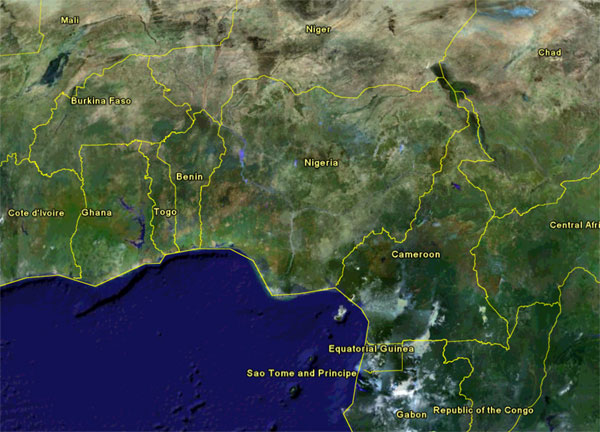

Image copyright Google Earth, MDA EarthSet, DigitalGlobe 2005

CIA-World Factbook Profile
FAO-Forestry Profile
World Resources Institute


Last updated: 4 Feb 2006


what's new | rainforests home | for kids | help | madagascar | search | about | languages | contact

Copyright Rhett Butler 1994-2009