TROPICAL RAINFORESTS
Mongabay.com is considered a leading source of information on tropical forests by some of the world's top ecologists and conservationists.

SIERRA LEONE

Sierra Leone Forest Figures

Forest Cover
Total forest area: 2,754,000 ha
% of land area: 38.5%

Primary forest cover: n/a
% of land area: n/a
% total forest area: n/a

Deforestation Rates, 2000-2005
Annual change in forest cover: -19,400 ha
Annual deforestation rate: -0.7%
Change in defor. rate since '90s: 7.3%
Total forest loss since 1990: -290,000 ha
Total forest loss since 1990:-9.5%

Primary or "Old-growth" forests
Annual loss of primary forests: n/a
Annual deforestation rate: n/a
Change in deforestation rate since '90s: n/a
Primary forest loss since 1990: n/a
Primary forest loss since 1990:n/a

Forest Classification
Public: n/a
Private: n/a
Other: n/a
Use
Production: 10.3%
Protection: 1.2%
Conservation: 2.8%
Social services: n/a
Multiple purpose: n/a
None or unknown: 85.7

Forest Area Breakdown
Total area: 2,754,000 ha
Primary: n/a
Modified natural: 2,751,000 ha
Semi-natural: n/a
Production plantation: 3,000 ha
Production plantation: n/a

Plantations
Plantations, 2005: 3,000 ha
% of total forest cover: 0.1%
Annual change rate (00-05): 80,000 ha

Carbon storage
Above-ground biomass: n/a M t
Below-ground biomass: n/a M t

Area annually affected by
Fire: 200,000 ha
Insects: n/a
Diseases: n/a

Number of tree species in IUCN red list
Number of native tree species: n/a
Critically endangered: 0
Endangered: 4
Vulnerable: 42

Wood removal 2005
Industrial roundwood: 137,000 m3 o.b.
Wood fuel: 6,414,000 m3 o.b.

Value of forest products, 2005
Industrial roundwood: n/a
Wood fuel: n/a
Non-wood forest products (NWFPs): n/a
Total Value: n/a


More forest statistics for Sierra Leone

Sierra Leone has substantial mineral reserves, but still depends much on slash-and-burn cultivation for agriculture. Logging, clearing for cattle grazing, fuelwood collection, and mining have produced a dramatic drop in forest cover in Sierra Leone since the 1980s.

Until 2002, Sierra Leone lacked a forest management system due to a brutal civil war that resulted in tens of thousands of deaths and the displacement of more than 2 million people (about one-third of the population). On paper, 55 protected areas covered 4.5 percent of Sierra Leone as of 2003. The country has 2,090 known species of higher plants, 147 mammals, 626 birds, 67 reptiles, 35 amphibians, and 99 fish species.

In June 2005, the Royal Society for the Protection of Birds (RSPB) and Bird-life International agreed to support a conservation-sustainable development project in the Gola Forest in southeastern Sierra Leone, the most important surviving fragment of rainforest in Sierra Leone.

Deforestation rates have increased 7.3 percent since the end of the civil war.

Mysterious pygmy hippo filmed in Liberia
(12/19/2011) Conservationists have captured the first ever footage (see video below) of the elusive pygmy hippo (Choeropsis liberiensis) in Liberia. The forest-dwelling, nocturnal species—weighing only a quarter of the size of the well-known common hippo (Hippopotamus amphibius)—has proven incredibly difficult to study. But the use of camera traps in Liberia's Sapo National Park has allowed researchers a glimpse into its cryptic life.


Sierra Leone creates rainforest park
(12/03/2011) Sierra Leone, one of Africa's poorest countries, today announced the establishment of Gola Rainforest National Park (GRNP), an area of forest home to chimpanzees, a key population of pygmy hippo, and hundreds of bird species, reports the Royal Society for the Protection of Birds (RSPB).


Loss of old growth forest continues
(10/06/2010) A new global assessment of forest stocks by the U.N. Food and Agriculture Organization (FAO) shows continuing loss of primary forests since 2005 despite gains in the extent of protected areas. FAO's Global Forest Resources Assessment 2010 reveals some 13 million hectares of forest were cleared between 2000 and 2010, down from around 16 million hectares per year during the 1990s. Loss of primary forest—mostly a consequence of logging—averaged 4.2 million hectares per year, down from 4.7 million hectares per year in the 1990s.


Sierra Leone cracks down on illegal logging by banning log exports
(01/02/2010) Sierra Leone has banned the transport and export of logs in an effort to crack down on illegal logging, reports AFP.


Sierra Leone bans timber exports
(01/15/2008) Sierra Leone has re-imposed a timber export ban after accusing foreign companies of illegally logging its forests, according to BBC News.


Poverty and corruption reduce effectiveness of rainforest parks
(07/09/2007) Poverty and corruption are linked to higher incidence of fire in tropical forest reserves, reports a new study published in the journal Ecological Applications. Poor, corrupt countries -- like Cambodia, Guatemala, Paraguay, and Sierra Leone -- have the least effective parks when measured in terms of the incidence of fire relative to surrounding "buffer" areas. The findings have significant implications for rainforest conservation efforts.


Goodbye to West Africa's Rainforests
(01/22/2006) West Africa's once verdant and extensive rainforests are now a historical footnote. Gone to build ships and furniture, feed hungry mouths, and supply minerals and gems to the West, the band of tropical forests that once extended from Guinea to Cameroon are virtually gone. The loss of West Africa's rainforests have triggered a number of environmental problems that have contributed to social unrest and exacerbated poverty across the region.


Unless otherwise specified, this article was written by Rhett A. Butler [Bibliographic citation for this page]

Other resources

Contact me if you have suggestions on other rainforest-related environmental sites and resources for this country.
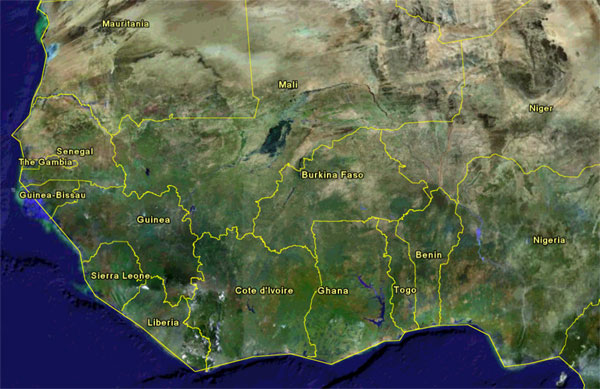

Image copyright Google Earth, MDA EarthSet, DigitalGlobe 2005

CIA-World Factbook Profile
FAO-Forestry Profile
World Resources Institute


Last updated: 4 Feb 2006


For kids

Tour: the Amazon

Rainforest news

Tour: Indonesia's rainforests

 Home
 What's New
 About
 Rainforests
   Mission
   Introduction
   Characteristics
   Biodiversity
   The Canopy
   Forest Floor
   Forest Waters
   Indigenous People
   Deforestation
   Consequences
   Saving Rainforests
   Amazon
   Borneo
   Congo
   New Guinea
   Sulawesi
   REDD
   Country Profiles
   Statistics
   Works Cited
   For Kids
   For Teachers
   Photos/Images
   Expert Interviews
   Rainforest News
  Forest data
   Global deforestation
   Tropical deforestation
   By country
   Deforestation charts
   Regional forest data
   Deforestation drivers
 XML Feeds
 Pictures
 Books
 Education
 Newsletter
 Contact


 CONTENTS
Rainforests
Tropical Fish
News
Madagascar
Pictures
Kids' Site
Languages
TCS Journal
About
Archives
Topics | RSS
Newsletter


 Other languages
Arabic
Bengali
Chinese (CN) (expanded)
Chinese (TW)
Croatian
Danish
Dutch
Farsi
French (expanded)
German (expanded)
Greek
Hindi
Hungarian
Indonesian
Italian
Japanese (expanded)
Javanese
Korean
Malagasy
Malay
Marathi
Norwegian
Polish
Portuguese (expanded)
Russian
Slovak
Spanish (expanded)
Swahili
Swedish
Ukrainian


 WEEKLY NEWSLETTER
 Email:


 INTERACT
Facebook
Twitter
Contact
Help
Photo store
Mongabay gear


what's new | rainforests home | for kids | help | madagascar | search | about | languages | contact

Copyright Rhett Butler 1994-2011

"Rainforest" is used interchangeably with "rain forest" on this site. "Jungle" is generally not used.