|
SOMALIA
|
Somalia Forest Figures
Forest Cover Total forest area: 7,131,000 ha % of land area: 11.4%
Primary forest cover: n/a % of land area: n/a % total forest area: n/a
Deforestation Rates, 2000-2005 Annual change in forest cover: -76,800 ha Annual deforestation rate: -1.0% Change in defor. rate since '90s: 10.3% Total forest loss since 1990: -1,151,000 ha Total forest loss since 1990:-13.9%
Primary or "Old-growth" forests Annual loss of primary forests: n/a Annual deforestation rate: n/a Change in deforestation rate since '90s: n/a Primary forest loss since 1990: n/a Primary forest loss since 1990:n/a
Forest Classification Public: 100% Private: n/a Other: n/a Use Production: n.s.% Protection: n/a Conservation: n/a Social services: n/a Multiple purpose: 100% None or unknown: n/a
Forest Area Breakdown Total area: 7,131,000 ha Primary: n/a Modified natural: 7,128,000 ha Semi-natural: n/a Production plantation: 3,000 ha Production plantation: n/a
Plantations Plantations, 2005: 3,000 ha % of total forest cover: n.s.% Annual change rate (00-05): n/a
Carbon storage Above-ground biomass: 624 M t Below-ground biomass: 150 M t
Area annually affected by Fire: n/a Insects: n/a Diseases: n/a
Number of tree species in IUCN red list Number of native tree species: n/a Critically endangered: 0 Endangered: 3 Vulnerable: 14
Wood removal 2005 Industrial roundwood: 132,000 m3 o.b. Wood fuel: 12,202,000 m3 o.b.
Value of forest products, 2005 Industrial roundwood: n/a Wood fuel: n/a Non-wood forest products (NWFPs): n/a Total Value: n/a
More forest statistics for Somalia
|
Somalia is a failed state and little is known about the current condition of its forests, which cover only a tiny portion of the country. U.N. data suggest that Somalia loses about 1 percent of its forests each year, mostly due to subsistence activities like fuelwood collection, agriculture, and use for building materials.
A recent story from Reuters ("Uphill struggle to preserve Somalia's wildlife," 11 Jan 2006 by Ed Stoddard) gave some insight into Somalia's environmental status. According to the article, Somalia had 40,000 elephants in 1980 but these are almost all gone today. There may be 500-750 lions in the country.
At last count by the World Conservation Monitoring Centre of the United Nations Environment Programme, there were 642 species of birds listed for Somalia, 222 mammals, 182 reptiles, 32 amphibians, and 3,028 species of plants.
Desertification is a problem in Somalia.
Delayed response to Somalia famine cost thousands of lives
(01/18/2012) A hesitant response by the international community likely led to thousands of unnecessary deaths in last year's famine in East Africa finds a new report released by Oxfam and Save the Children. The report, entitled A Dangerous Delay, says that early warning systems worked in informing the international community about the likelihood of a dire food crisis in East Africa, however a "culture of risk aversion" led to months-long delays. By the time aid arrived it was already too late for many. The British government has estimated somewhere between 50,000 and 100,000 people perished in the famine, half of whom were likely children under five.
Top 10 Environmental Stories of 2011
(12/22/2011) Many of 2011's most dramatic stories on environmental issues came from people taking to the streets. With governments and corporations slow to tackle massive environmental problems, people have begun to assert themselves. Victories were seen on four continents: in Bolivia a draconian response to protestors embarrassed the government, causing them to drop plans to build a road through Tipnis, an indigenous Amazonian reserve; in Myanmar, a nation not known for bowing to public demands, large protests pushed the government to cancel a massive Chinese hydroelectric project; in Borneo a three-year struggle to stop the construction of a coal plant on the coast of the Coral Triangle ended in victory for activists; in Britain plans to privatize forests created such a public outcry that the government not only pulled back but also apologized; and in the U.S. civil disobedience and massive marches pressured the Obama Administration to delay a decision on the controversial Keystone XL pipeline, which would bring tar sands from Canada to a global market.
Famine in Africa: Can Reforestation Improve Food Security?
(09/14/2011) Millions of people across the Horn of Africa are suffering under a crippling regional drought and tens of thousands have died during the accompanying famine. Refuge camps in Somalia, Kenya, and Ethiopia are swelling with the hungry.
Photos: World Food Program works to save lives in East Africa famine
(08/28/2011) Over 12 million people across East Africa are imperiled by a hunger crisis brought on by extreme drought. The worst of the crisis is in Somalia, where famine has been declared in 5 areas of Somalia to date—the first famine to be declared by the UN in three decades. Somalia is unique, because here the drought has been exacerbated by a long-failed government and militants. Refugee camps have been set up in Kenya and Ethiopia, but are strained. A number of aid groups are working on the ground to provide emergency food and medical attention to hunger victims, but funding is still below what is needed. The largest group is probably the UN's World Food Program (WFP). Mongabay.com spoke to Dena Gubaitis, Communications Officer for the WFP, for background on the famine and how relief efforts are going on the ground.
Famine spreads: 29,000 young children perish
(08/04/2011) As the UN announces that famine has spread in Somalia to three additional regions (making five in total now), the US has put the first number to the amount of children under 5 who have so far perished from starvation in the last 90 days: 29,000. Nearly half of the total population of Somalia is currently in need of emergency food assistance. Yet, the al Qaeda-linked group al-Shabaab, which controls parts of Somalia, has made bringing assistance to many of the malnourished incredibly difficult, if not impossible. The famine in Somalia has been brought-on by lack of governance combined with crippling droughts throughout East Africa, which some experts have linked to climate change. High food prices worldwide and a lagging response by the international community and donors have made matters only worse.
Tens of thousands starving to death in East Africa
(07/20/2011) As the US media is focused like a laser on theatric debt talks and the UK media is agog at the heinous Rupert Murdoch scandal, millions of people are undergoing a starvation crisis in East Africa. The UN has upgraded the disaster—driven by high food prices, conflict, and prolonged drought linked by some to climate change—to famine in parts of Somalia today. Mark Bowden, UN humanitarian coordinator for Somalia, has said that tens of thousands Somalis have died from malnutrition recently, "the majority of whom were children."
Worst drought in 60 years brings starvation fears to East Africa
(06/30/2011) A prolonged drought in East Africa is bringing many of the region's impoverished to their knees: the World Food Program (WFP) is warning that 10 million people in the region are facing severe shortages. While not dubbed a famine yet, experts say it could become one. Meanwhile, a recent study by FEWS NET/USGS has revealed that the current drought is the worst in 11 of 15 East African regions since 1950-51. Worsening droughts are one of the predictions for the region as the world grows warmer.
From Cambodia to California: the world's top 10 most threatened forests
(02/02/2011) Growing populations, expanding agriculture, commodities such as palm oil and paper, logging, urban sprawl, mining, and other human impacts have pushed many of the world's great forests to the brink. Yet scientists, environmentalists, and even some policymakers increasingly warn that forests are worth more standing than felled. They argue that by safeguarding vulnerable biodiversity, sequestering carbon, controlling erosion, and providing fresh water, forests provide services to humanity, not to mention the unquantifiable importance of having wild places in an increasingly human-modified world. Still, the decline of the world's forests continues: the FAO estimating that around 10 million hectares of tropical forest are lost every year. Of course, some of these forests are more imperiled than others, and a new analysis by Conservation International (CI) has catalogued the world's 10 most threatened forests.
Deforestation continues in Somalia despite charcoal ban
(01/23/2011) IRIN News, a news service operated by the UN Office for Humanitarian Affairs, has reported that charcoal production in Somalia is continuing to rise despite a government ban. Charcoal production has long been one of the principal drivers of deforestation in Somalia. The charcoal, which is usually smuggled out of the country illegally for sale in the Gulf States, also provides a source of income for Islamic militias like al Shabaab, which control large parts of Somalia in open defiance of the Western-backed government.
Suggested reading - Books
Unless otherwise specified, this article was written by Rhett A. Butler [Bibliographic citation for this page]
Other resources
Contact me if you have suggestions on other rainforest-related environmental sites and resources for this country.
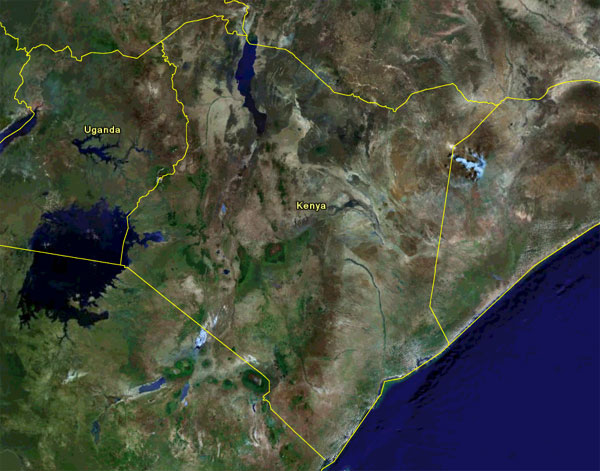
Image copyright Google Earth, MDA EarthSet, DigitalGlobe 2005
Somalia
CIA-World Factbook Profile
FAO-Forestry Profile
World Resources Institute
Last updated: 4 Feb 2006
|
|