About this site
Providing tropical forest news, statistics, photos, and information, rainforests.mongabay.com is the world's most popular rainforest site. [more] |
Weekly Newsletter
Mongabay will never distribute your email address or send spam.
Share
|
|
|
|
UGANDA
|
Uganda Forest Figures
Forest Cover Total forest area: 3,627,000 ha % of land area: 18.4%
Primary forest cover: n/a % of land area: n/a % total forest area: n/a
Deforestation Rates, 2000-2005 Annual change in forest cover: -86,400 ha Annual deforestation rate: -2.2% Change in defor. rate since '90s: 21.2% Total forest loss since 1990: -1,297,000 ha Total forest loss since 1990:-26.3%
Primary or "Old-growth" forests Annual loss of primary forests: n/a Annual deforestation rate: n/a Change in deforestation rate since '90s: n/a Primary forest loss since 1990: n/a Primary forest loss since 1990:n/a
Forest Classification Public: 29.8% Private: 70.2% Other: n/a Use Production: 14.9% Protection: n/a Conservation: 14.8% Social services: n/a Multiple purpose: n/a None or unknown: 70.2
Forest Area Breakdown Total area: 3,627,000 ha Primary: n/a Modified natural: 3,591,000 ha Semi-natural: n/a Production plantation: 36,000 ha Production plantation: n/a
Plantations Plantations, 2005: 36,000 ha % of total forest cover: 1% Annual change rate (00-05): 200,000 ha
Carbon storage Above-ground biomass: 218 M t Below-ground biomass: 59 M t
Area annually affected by Fire: n/a Insects: n/a Diseases: n/a
Number of tree species in IUCN red list Number of native tree species: n/a Critically endangered: 3 Endangered: 4 Vulnerable: 33
Wood removal 2005 Industrial roundwood: 4,408,000 m3 o.b. Wood fuel: 42,041,000 m3 o.b.
Value of forest products, 2005 Industrial roundwood: n/a Wood fuel: $70,000 Non-wood forest products (NWFPs): n/a Total Value: $70,000
More forest statistics for Uganda
|
Before the rule of Idi Amin, Uganda had a relatively sound environmental record. During his reign (1971-1979), the forests suffered from civil and political strife. From 1971 to 1987, Uganda lost 50 percent of its forests, including virtually all of its primary forests.
Between 1990 and 2005, Uganda lost 26.3 percent of its remaining forest cover, and deforestation continues today at a rate of 2.2 percent per year, mostly due to subsistence farming, cutting for fuelwood, and colonization by the burgeoning population.
While Uganda is famous for its mountain gorillas, it is home to some of the highest concentrations of biodiversity in Africa. More than 5,000 plant species are found in the country along with 345 mammals, 1,015 birds, 165 reptiles, and 43 amphibians.
Today very little of Uganda's forest cover is considered primary forest by the U.N. In spite of this, more than 25 percent of the country is under some form of protection.
Pictures of Uganda
Recent articles | Uganda news updates | XML
Ugandan president continues to undermine national forest reserves
(11/04/2008) Ugandan President Yoweri Museveni — a leader who has repeatedly sought to hand forest areas over to industrial developers and undermine the sanctity of reserves — is now blaming the country's forestry agency for deforestation in Uganda.
Does logging contribute to AIDS deaths in Africa?
(06/14/2008) Logging activities in tropical Africa may pose hidden health risks to wildlife and humans according to a veterinary pathobiologist speaking at a scientific conference in Paramaribo, Suriname.
Dirt-munching helps protect chimps from malaria
(01/10/2008) Soil ingestion helps chimps protect themselves from malaria, reports a new study published in the journal Naturwissenschaften. Apparently geophagy, as the deliberate behvaior is known, increases the potency of ingested plants with anti-malarial properties.
Uganda renews plans to log rainforest reserve for sugar cane
(12/21/2007) Uganda's President Yoweri Museveni on Friday revived a controversial plan to grant a forest reserve to commercial sugar cane interests.
Parasites a key to the decline of red colobus monkeys in forest fragments
(10/25/2007) Forest fragmentation threatens biodiversity, often causing declines or local extinctions in a majority of species while enhancing the prospects of a few. A new study from the University of Illinois shows that parasites can play a pivotal role in the decline of species in fragmented forests. This is the first study to look at how forest fragmentation increases the burden of infectious parasites on animals already stressed by disturbances to their habitat.
Uganda cancels controversial rainforest logging plan
(10/18/2007) Uganda's government abandoned a controversial plan to grant protected rainforest land to a sugar company, reports Reuters.
The other side of carbon trading
(08/29/2007) Planting trees in Uganda to offset greenhouse-gas emissions in Europe seemed like a good idea - until farmers were evicted from their land to make room for a forest.
Rare gorillas slaughtered in mass killing
(07/24/2007) At least four critically endangered gorillas have been killed in Democratic Republic of Congo's Virunga National Park. National Geographic News reports they were shot "execution-style". Illegal charcoal harvesters are leading suspects in the slaying. Two other gorillas are missing and feared dead.
Uganda abandons rainforest logging for palm oil
(05/27/2007) The Ugandan government abandoned plans to log thousands of hectares of rainforest on Bugala island in Lake Victoria for a palm oil plantation, Reuters reported Saturday.
Uganda rainforest reserve safe, for now
(05/23/2007) Uganda's cabinet has suspended a proposal to allow a sugarcane grower to convert part of Mabria rainforest reserve for a plantation, reports Reuters. The plan, a pet project of president Yoweri Museveni, faced widespread opposition that was capped by deadly riots.
Rare mountain gorillas in Uganda on the increase
(04/20/2007) High endangered mountain gorillas in Uganda are increasing, reports a new census by the Uganda Wildlife Authority, the Wildlife conservation Society, the Max Planck Institute of Anthropology and other groups. The population of gorillas in Bwindi Impenetrable National Park has increased from 320 in 2002 to 340 today. A 1997 study found 300 gorillas, indicating that the park population has increased by 20 percent over the past decade. Aggressive conservation measures have been the key say researchers.
Controversial rainforest clearing approved in Uganda
(03/26/2007) Uganda's prime minister Apolo Nsibambi has approved a plan to clear thousands of hectares of protected rainforest for a sugarcane plantation, reported the New Vision newspaper, a government-owned publication.
New monkey species in Uganda
(02/18/2007) Uganda may soon have a new species of monkey according to a report published in Kampala's New Vision newspaper. Dr. Colin Groves of the Australian National University told New Vision that the local population of the gray-cheeked mangabey (Lophocebus albigena) will soon be designated as a unique species, the Ugandan gray-cheeked mangabey (Lophocebus ugandae).
President Museveni needs to do what's best for Uganda
(12/15/2006) In recent months Ugandan president Yoweri Museveni has moved to destroy some of Uganda's last remaining primary rainforests to give land to politically-connected plantation owners. Personally intervening in two disputes, one in Mabira Forest Reserve and the other on Bugala island in Lake Victoria, Museveni has argued that his country urgently needs such projects to industrialize and bring a better quality of life to Ugandans. He would be wrong.
President Museveni again moves against Uganda's forests
(12/12/2006) Ugandan president Yoweri Museveni has again taken action against rainforest conservation in Uganda, moving to hand a protected forest reserve over to private agricultural interests intent on clearing trees, according to a report from Reuters.
Sugar cane plantation threatens rare forest in Uganda
(11/30/2006) A plan to clear a protected forest reserve for sugar cane has sparked controversy in Uganda according to a report from Reuters. Uganda-based Mehta Group, owner of a sugar plantation that borders Mabira forest, a nature reserve since 1932, asked Ugandan President Yoweri Museveni to consider a proposal that would level about 7,000 hectares, or about a quarter of the reserve which is home to 312 species of tree, 287 species of bird and 199 species of butterfly.
Emissions for forest conservation scheme could net Uganda $50 million or more per year
(11/06/2006) Uganda could earn tens of millions of dollars through a global warming proposal under consideration this week at U.N. climate negotiations in Nairobi, Kenya.
Africa's glaciers gone by 2025
(05/15/2006) Fabled equatorial icecaps will disappear within two decades, because of global warming, a study British and Ugandan scientists has found. In a paper to be published 17 May in Geophysical Research Letters, they report results from the first survey in a decade of glaciers in the Rwenzori Mountains of East Africa. An increase in air temperature over the last four decades has contributed to a substantial reduction in glacial cover, they say.
Lake Victoria illegally drained for electricity in Uganda
(02/08/2006) Lake Victoria, Africa's largest freshwater lake, is being covertly drained for hydroelectric power according to an article published in the Feb. 11 New Scientist magazine. The report, written by Fred Pearce, says that Uganda is violating a 50-year-old international agreement designed to protect the lake. The following is a release from the New Scientist.
Deforestation rates jump in Uganda and Burundi, fall in Rwanda
(01/25/2006) Tropical deforestation rates have skyrocketed in Uganda and Burundi, while declining significantly in Rwanda according to mongabay.com's analysis of data from the Food and Agriculture Organization (FAO) of the United Nations.
Uganda imports rhinos from Kenya
(07/26/2005) Uganda has imported four rhinos from Kenya according to the Uganda Wildlife Authority (UWA). UWA hopes to develop a captive breeding program in an effort to reintroduce rhinos after their disappearance from the country in the 1960s due to poaching.
Suggested reading - Books
Unless otherwise specified, this article was written by Rhett A. Butler [Bibliographic citation for this page]
Other resources
Contact me if you have suggestions on other rainforest-related environmental sites and resources for this country.
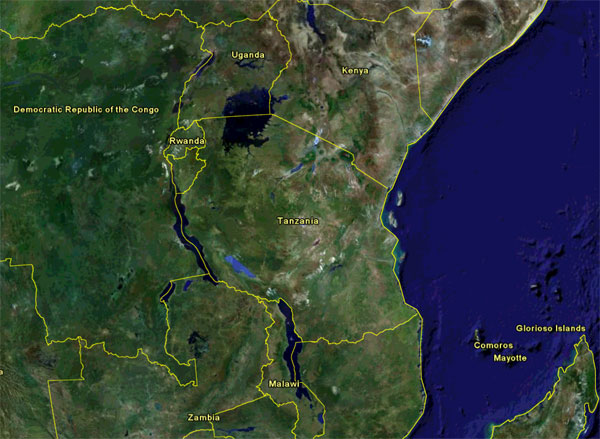
Image copyright Google Earth, MDA EarthSet, DigitalGlobe 2005
CIA-World Factbook Profile
FAO-Forestry Profile
World Resources PFD
Last updated: 4 Feb 2006 |
|
|