
Rainforests country profiles
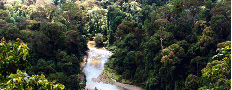
VENEZUELA
By Rhett Butler
 |
Venezuela, one of the ten most biodiverse countries on Earth, is home to extensive rainforests ranging from cloud forests of the coastal mountain ranges to the rainforests of the Guiana shield and Amazon basin. Venezuela has more than 21,000 species of plants, 353 mammal species, 323 reptile species, 1,400 bird species, and 288 amphibians.
|
Venezuela, one of the ten most biodiverse countries on Earth, is home to extensive rainforests ranging from cloud forests of the coastal mountain ranges to the rainforests of the Guiana shield and Amazon basin. Venezuela has more than 21,000 species of plants, 353 mammal species, 323 reptile species, 1,400 bird species, and 288 amphibians.
Forest cover and loss in Venezuela
Using a ten percent tree cover as a threshold, forests and plantations covered nearly two-thirds of Venezuela's land mass, or about 59 million hectares, in 2012, according to researchers led by Matt Hansen (2013). Dense forests — areas with more than 50 percent tree cover — amounted to just under 54 million hectares.
The largest extent of forests in Venezuela are found in Bolivar, which accounts for about a third of the country's forests. Amazonas is second with about 30 percent of Venezuela's forest cover.
Hansen's research shows that Venezuela lost 1.25 million hectares of forest cover, or 2.1 percent, between 2001-2012.
Cattle ranching is the biggest driver of deforestation in Venezuela. In the 1980s and 1990s, gold mining and logging were important causes of deforestation and forest degradation, but logging has dwindled in recent years. Gold mining still causes intense damage where it occurs, but limited to southern reaches of the country. There is potential to expand coal and bauxite mining in the country, potentially putting forests at risk.
In the mid-2000s, former president Hugo Chavez proposed a controversial pipeline that would run 5,000 miles south through the heart of the Amazon rainforest. But the project failed to get off the ground.
On paper Venezuela has protected more than a third of its land mass in its system of parks and reserves. But many of these protected areas have suffered from incursion by illegal loggers and miners.
Charts showing forest cover and loss in Venezuela


Venezuela environmental news | XML | pictures
Suggested reading - Books
CIA-World Factbook Profile
FAO-Forestry Profile
VenezuelAnalysis.com
Last updated: 23 Jul 2014
 |
Venezuela, one of the ten most biodiverse countries on Earth, is home to extensive rainforests ranging from cloud forests of the coastal mountain ranges to the rainforests of the Guiana shield and Amazon basin. Venezuela has more than 21,000 species of plants, 353 mammal species, 323 reptile species, 1,400 bird species, and 288 amphibians.
|
Venezuela, one of the ten most biodiverse countries on Earth, is home to extensive rainforests ranging from cloud forests of the coastal mountain ranges to the rainforests of the Guiana shield and Amazon basin. Venezuela has more than 21,000 species of plants, 353 mammal species, 323 reptile species, 1,400 bird species, and 288 amphibians.
Forest cover and loss in Venezuela
Using a ten percent tree cover as a threshold, forests and plantations covered nearly two-thirds of Venezuela's land mass, or about 59 million hectares, in 2012, according to researchers led by Matt Hansen (2013). Dense forests — areas with more than 50 percent tree cover — amounted to just under 54 million hectares.
The largest extent of forests in Venezuela are found in Bolivar, which accounts for about a third of the country's forests. Amazonas is second with about 30 percent of Venezuela's forest cover.
Hansen's research shows that Venezuela lost 1.25 million hectares of forest cover, or 2.1 percent, between 2001-2012.
| Total forest area | Dense forest area | Forest gain | Forest loss | Total land area | ||||||
| >10% tree cover (ha) | % total land cover | >50% tree cover (ha) | % total land cover | 2001-2012 (ha) | % total forest cover | 2001-2012 (ha) | % total forest cover | (ha) | ||
| Amazonas | 17646498 | 97.0% | 17461864 | 95.9% | 17304455 | 98.1% | 64404 | 0.4% | 18201001 | |
| Anzoátegui | 1706637 | 36.8% | 1276284 | 27.5% | 753221 | 44.1% | 108065 | 6.3% | 4643486 | |
| Apure | 1688281 | 23.5% | 1141777 | 15.9% | 785052 | 46.5% | 60496 | 3.6% | 7174841 | |
| Aragua | 396807 | 57.9% | 285217 | 41.6% | 186184 | 46.9% | 11131 | 2.8% | 685865 | |
| Barinas | 1447323 | 40.2% | 1043536 | 29.0% | 700955 | 48.4% | 95093 | 6.6% | 3602000 | |
| Bolivar | 19421754 | 82.5% | 18760215 | 79.6% | 18337115 | 94.4% | 231071 | 1.2% | 23553487 | |
| Carabobo | 234789 | 53.2% | 181116 | 41.0% | 143206 | 61.0% | 4126 | 1.8% | 441361 | |
| Cojedes | 691685 | 47.9% | 504180 | 34.9% | 318302 | 46.0% | 17548 | 2.5% | 1443283 | |
| Delta Amacuro | 3428695 | 88.3% | 3369546 | 86.8% | 3321300 | 96.9% | 10875 | 0.3% | 3882978 | |
| Distrito Capital | 17205 | 52.5% | 12581 | 38.4% | 8372 | 48.7% | 185 | 1.1% | 32753 | |
| Falcón | 1113569 | 41.3% | 817579 | 30.3% | 575889 | 51.7% | 71442 | 6.4% | 2699558 | |
| Guсrico | 1784065 | 26.9% | 1072691 | 16.2% | 434595 | 24.4% | 87272 | 4.9% | 6640976 | |
| Lara | 818664 | 43.1% | 556360 | 29.3% | 392438 | 47.9% | 33998 | 4.2% | 1901641 | |
| Mérida | 853442 | 66.5% | 732921 | 57.1% | 579678 | 67.9% | 20079 | 2.4% | 1282709 | |
| Miranda | 721921 | 84.9% | 656758 | 77.2% | 585056 | 81.0% | 18684 | 2.6% | 850334 | |
| Monagas | 1387098 | 48.4% | 1217622 | 42.5% | 1066743 | 76.9% | 141414 | 10.2% | 2866532 | |
| Nueva Esparta | 17700 | 17.6% | 10782 | 10.7% | 7283 | 41.1% | 121 | 0.7% | 100483 | |
| Portuguesa | 861922 | 44.6% | 687801 | 35.6% | 473583 | 54.9% | 55429 | 6.4% | 1934192 | |
| Sucre | 878466 | 82.3% | 813208 | 76.1% | 751306 | 85.5% | 19981 | 2.3% | 1067948 | |
| Tсchira | 745251 | 69.2% | 617187 | 57.3% | 512590 | 68.8% | 34000 | 4.6% | 1076809 | |
| Trujillo | 510757 | 63.3% | 416025 | 51.5% | 320354 | 62.7% | 18262 | 3.6% | 807327 | |
| Vargas | 83958 | 84.9% | 76654 | 77.5% | 68320 | 81.4% | 1094 | 1.3% | 98856 | |
| Yaracuy | 384824 | 62.0% | 327978 | 52.8% | 274653 | 71.4% | 11667 | 3.0% | 620965 | |
| Zulia | 2012127 | 46.2% | 1704247 | 39.1% | 1465629 | 72.8% | 128638 | 6.4% | 4353233 | |
| Peru | 58853438 | 65.4% | 53744128 | 59.7% | 49366278 | 83.9% | 1245073 | 2.1% | 89962615 | |
Cattle ranching is the biggest driver of deforestation in Venezuela. In the 1980s and 1990s, gold mining and logging were important causes of deforestation and forest degradation, but logging has dwindled in recent years. Gold mining still causes intense damage where it occurs, but limited to southern reaches of the country. There is potential to expand coal and bauxite mining in the country, potentially putting forests at risk.
In the mid-2000s, former president Hugo Chavez proposed a controversial pipeline that would run 5,000 miles south through the heart of the Amazon rainforest. But the project failed to get off the ground.
On paper Venezuela has protected more than a third of its land mass in its system of parks and reserves. But many of these protected areas have suffered from incursion by illegal loggers and miners.
Charts showing forest cover and loss in Venezuela


Venezuela environmental news | XML | pictures
|
Venezuela
Forest Figures
Forest Cover Total forest area: 47,713,000 ha % of land area: 54.1% Primary forest cover: n/a % of land area: n/a % total forest area: n/a Deforestation Rates Annual change in forest cover: -287,600 ha Annual deforestation rate: -0.6% Change in rate 90-00 vs 00-05: 5.9% Annual loss of primary forests: n/a Annual deforestation rate: n/a Change in rate 90-00 vs 00-05: n/a Forest Classification Public: n/a Private: n/a Other: n/a Production: 38.1% Protection: n/a Conservation: 61.9% Social services: n/a Multiple purpose: n/a None or unknown: n/a Forest Area Breakdown Total area: 47,713,000 ha Primary: n/a Modified natural: n/a Semi-natural: n/a Production plantation: n/a Production plantation: n/a Plantations Plantations, 2005: n/a % of total forest cover: n/a Annual change rate (00-05): n/a - M t Below-ground biomass: - M t Area annually affected by Fire: 14,000 ha Insects: n/a Diseases: n/a Number of tree species in IUCN red list Number of native tree species: 1,360 Critically endangered: 3 Endangered: 6 Vulnerable: 50 Wood removal 2005 Industrial roundwood: 8121000 m3 o.b. Wood fuel: 21000 m3 o.b. Value of forest products, 2005 Industrial roundwood: $43,856,000 Wood fuel: n/a Non-wood forest products (NWFPs): n/a Total Value: $43,856,000 More forest statistics for Venezuela |
- Lonely Planet Venezuela
- Birds of Venezuela
- Mammals of the Neotropics, Volume 1 : The Northern Neotropics: Panama, Colombia, Venezuela, Guyana, Suriname, French Guiana (Eisenberg, John F//Mammals of the Neotropics)
- Venezuela Map
- Venezuela, 4th: The Bradt Travel Guide
- Insight Guides Venezuela
- Footprint Venezuela Handbook
CIA-World Factbook Profile
FAO-Forestry Profile
VenezuelAnalysis.com
Last updated: 23 Jul 2014
