|
ZAMBIA
|
Zambia Forest Figures
Forest Cover Total forest area: 42,452,000 ha % of land area: 57.1%
Primary forest cover: n/a % of land area: n/a % total forest area: n/a
Deforestation Rates, 2000-2005 Annual change in forest cover: -444,800 ha Annual deforestation rate: -1.0% Change in defor. rate since '90s: 10.0% Total forest loss since 1990: -6,672,000 ha Total forest loss since 1990:-13.6%
Primary or "Old-growth" forests Annual loss of primary forests: n/a Annual deforestation rate: n/a Change in deforestation rate since '90s: n/a Primary forest loss since 1990: n/a Primary forest loss since 1990:n/a
Forest Classification Public: 100% Private: n/a Other: n/a Use Production: 7.1% Protection: 4.2% Conservation: 15% Social services: n/a Multiple purpose: 73.7% None or unknown: n/a
Forest Area Breakdown Total area: 42,452,000 ha Primary: n/a Modified natural: 42,377,000 ha Semi-natural: n/a Production plantation: 75,000 ha Production plantation: n/a
Plantations Plantations, 2005: 75,000 ha % of total forest cover: 0.2% Annual change rate (00-05): n/a
Carbon storage Above-ground biomass: 1,821 M t Below-ground biomass: 492 M t
Area annually affected by Fire: n/a Insects: n/a Diseases: n/a
Number of tree species in IUCN red list Number of native tree species: 2,621 Critically endangered: 0 Endangered: 11 Vulnerable: 14
Wood removal 2005 Industrial roundwood: 1,053,000 m3 o.b. Wood fuel: 8,798,000 m3 o.b.
Value of forest products, 2005 Industrial roundwood: n/a Wood fuel: n/a Non-wood forest products (NWFPs): n/a Total Value: n/a
More forest statistics for Zambia
|
Despite numerous parks which protect more than 40 percent of the country, Zambia has serious problems with poaching—which has dramatically reduced elephant and rhino populations—and deforestation. Forest loss is mostly the by-product of widespread slash-and-burn agriculture, and primary tropical forests have disappeared from the country.
The hardwood forests of the Western grasslands are in much better shape, but logging is on the rise.
Zambia is home to nearly 4,800 species of plants, 770 birds, 233 mammals, 143 reptiles, and 57 amphibians.
Fertilizer trees boost yields in Africa
(10/16/2011) Fertilizer trees—which fix nitrogen in the soil—have improved crops yields in five African countries, according to a new study in the International Journal of Agricultural Sustainability. In some cases yields have doubled with the simple addition of nitrogen-soaking trees. The research found that fertilizer trees could play a role in alleviating hunger on the continent while improving environmental conditions.
Innovative program saves wildlife, protects forests, and fights poverty in Africa
(08/23/2011) Luangwa Valley in Zambia is home to stunning scenes of Africa wildlife: elephants, antelopes, zebra, buffalo, leopards, hyena, and lions all thrive in Luangwa's protected areas, while the Luangwa River is known for multitude of snapping crocodiles and its superabundant herds of hippos. In fact, the area's hippos were filmed for the BBC's program Life, including a dramatic battle between two males (see below). Yet as in many such places in Africa, abundant plains and forest wildlife bump up against the needs of impoverished local people. The resulting conflict usually ends in large-scale wildlife declines; the same trend was documented in the Luangwa Valley until a unique initiative began to make a difference not only in the life of animals, but of people as well.
Record number of nations hit all time temperature highs
(11/23/2010) To date, nineteen nations have hit or matched record high temperatures this year, according to Jeff Master's Wunder Blog, making 2010 the only year to have so many national records. In contrast, no nation this year has hit a record cold temperature.
Rise in poaching pushes CITES to vote 'no' to ivory sales
(03/22/2010) The Convention on International Trade in Endangered Species (CITES) has pleased conservationists with its decision to not allow the one-off sales of ivory from government stockpiles in Tanzania and Zambia given the recent rise in elephants poaching in Africa.
Unique acacia tree could play vital role in turning around Africa's food crisis
(08/24/2009) Scientists have discovered that an acacia tree, long used by farmers in parts of Africa, could dramatically raise food yields in Africa. The acacia tree Faidherbia albida, also known as Mgunga in Swahili, possesses the unique ability to provide much-needed nitrogen to soil.
Camping in the Okavango Delta in Botswana
(08/19/2009) The first animal we saw in the Okavango was unmistakable. Although far away, we could easily make it out with its telltale trunk: an African elephant—the world’s largest land animal—was striding peaceably through the delta’s calm waters. We watched, entranced, from the mokoro, a small boat powered and steered by a local wielding a long pole to push the craft along.
NASA study shows global warming will diminish rainfall in East Africa, worsening hunger
(08/06/2008) A new NASA-backed study has found a link between a warming Indian Ocean and reduced rainfall in eastern and southern Africa. The results suggest that rising sea temperatures could exacerbate food problems in some of the continent's most famine-prone regions.
Photos: Hippos threatened in Africa
(01/07/2008) As the sun sets on the Luangwa River in Zambia, a male hippo throws its mouth open in a yawn as wide as a canyon. Night is falling as the hippo herds break to the banks to follow their regular paths to their feeding grounds. Their huge, round hooves made muddy imprints during the rainy season, and have dried to concrete craters along a trail the hippos follow to graze in grassy glades.
Low deforestation countries to see least benefit from carbon trading
(08/13/2007) Countries that have done the best job protecting their tropical forests stand to gain the least from proposed incentives to combat global warming through carbon offsets, warns a new study published in Tuesday in the journal Public Library of Science Biology (PLoS). The authors say that "high forest cover with low rates of deforestation" (HFLD) nations "could become the most vulnerable targets for deforestation if the Kyoto Protocol and upcoming negotiations on carbon trading fail to include intact standing forest."
Agents of death for wildlife become jewelry in Zambia
(07/12/2007) Craftswomen in Zambia are turning snares formerly used to illegal kill wildlife into jewelry. Called "snareware", the handmade jewelry is part of a program that has grossed $350,000 for rural communities and helped protect endangered wildlife.
Suggested reading - Books
Unless otherwise specified, this article was written by Rhett A. Butler [Bibliographic citation for this page]
Other resources
Contact me if you have suggestions on other rainforest-related environmental sites and resources for this country.
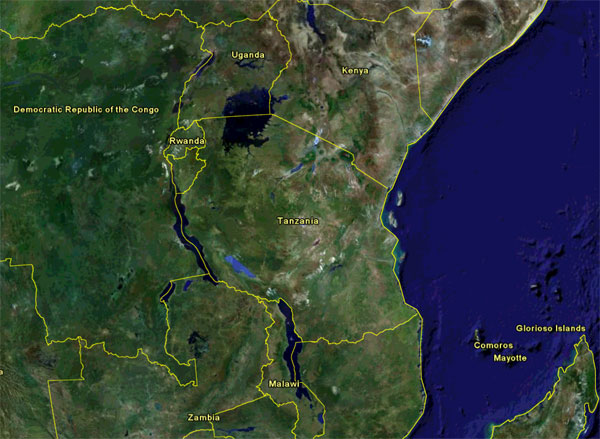
Image copyright Google Earth, MDA EarthSet, DigitalGlobe 2005
Zambia Conservation
Zambia Forests
WCS Zambia
CIA-World Factbook Profile
FAO-Forestry Profile
World Resources PDF
Last updated: 4 Feb 2006
|
|