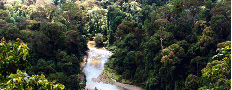
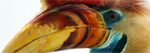
Lingering beside a small stream in the Malaysian rainforest
of Sabah, on the island of Borneo, I watch the water move swiftly over worn, round stones. The pace of the flow
quickens as the stream cascades over a short falls into a clear pool. Vibrantly colored butterflies in shades of
yellow, orange, and green flirt with columns of light that penetrates the dense canopy. The raucous calls of hornbills
challenge the melodic drone of cicadas. Though the forest is never silent or still it brings a deep sense of calm.
I sit with my feet in the cool water, picking over my clothes in search of leaf leaches, who seek a feeding opportunity
in every crease of material. As I remove these brightly hued creatures, I am content to watch a lone male orangutan
silently make his way through the branches above the stream. The idyllic setting and the company of my red bearded
simian companion provide the perfect end to my half day trek.
Such wildlands provide me with a mental and emotional escape from the daily hustle and bustle and I have come to greatly appreciate places of natural wonder.
I have long had a fascination with the natural world and its creatures but the idea for this book arose out of
deep sadness. Eight weeks after leaving that tract of Malaysian rainforest that had filled me with happiness, I
learned the forest was gone. Logged for wood chips to supply a paper pulp plant, this place of natural wonder and
beauty was lost forever. The orangutan, the hornbills, the butterflies, and even the leaches would now have to
make do in their now dramatically changed environment.
Despite my few years in the forest, this was not the first time I had lost such a special place, nor will it be
the last.
These personal losses have long troubled me, but the loss of that small section of forest in Borneo created the
urgency to act upon a thought that had been nagging me. While environmental losses and degradation of the rainforests
have yet to reach the point of collapse, the continuing disappearance of wildlands and loss of its species is disheartening.
I feel sorrow for those who have yet had the privilege to experience the magnificence of these places and try to
picture how - should biodiversity losses continue to mount - I will explain to my grandchildren why these places
of natural wonder that I enjoyed in my youth no longer exist.
The lesson of A Place Out of Time is we may not have to accept this future. A lot can still be done. Using our
intelligence and ingenuity, the human species can preserve biodiversity and unique places for future generations,
without compromising the quality of life for present populations.
Me speaking about the inspiration for mongabay.com during a test run ahead of my TEDxYouth talk.
A Place Out of Time is written for those who have an interest in the natural world. It is scripted to appeal to
a broad audience so that readers from grade school students to stockbrokers to plumbers can enjoy and learn from
this book. I have sought to broaden the reach and horizons of this text by incorporating and bringing together
far flung (and sometimes seemingly unrelated) information from a variety of sources not easily accessible to most
readers. In the process I have tried to simplify the sometimes complex subject matter and provide some insight
into the current economic, political, and social climate for tropical rainforests.
Carbon dioxide (CO2) emissions generated from mongabay.com operations (server, data transfer, travel) are mitigated through an association with Anthrotect,
an organization working with Afro-indigenous and Embera communities to protect forests in Colombia's Darien region. Anthrotect is protecting the habitat of mongabay's mascot: the scale-crested pygmy tyrant.
"Rainforest" is used interchangeably with "rain forest" on this site. "Jungle" is generally not used.